The cost of tree shaping and pruning in Otumoetai depends on the tree, access and work required. Crown thinning or lifting, deadwood removal, shaping and handling clippings all affect the scope. There is no single price that applies to every tree.
It’s natural to want a clear idea of the cost before work begins, especially when branches crowd a garden or block light. To plan effectively, be clear about the result you want and consider how the tree’s size and position, the pruning required and debris handling affect the job.
This guide explains how to plan pruning, manage clippings and distinguish crown thinning, lifting, deadwood removal and form pruning. You’ll get a clearer picture of what affects the cost and how to choose work that suits the tree and your property.
Key Takeaways
- Set your cleanup expectations before pruning begins, as the way clippings are handled affects the job’s scope.
- Choose crown thinning or lifting to address the specific issue, such as crowded growth or branches sitting too low.
- Look for deadwood that needs removal, and aim for clean cuts that avoid damage to the stem.
- Prune for form with the tree’s future shape in mind, rather than removing growth without a clear purpose.
Clippings and debris removal
- Before deciding on cuts, establish whether planning controls apply to the tree. Tauranga City Council requirements can depend on the property and tree, so there isn’t one permission rule for every Otumoetai pruning job. Some notable or protected trees may require consent, depending on their status and the proposed work. Clarify this before setting the scope.
- Choose the timing to suit the tree and the reason for pruning. There’s no single best season for every tree in Otumoetai: species, flowering and the type of cut all matter. Some deciduous trees, for example, are pruned while dormant, while flowering trees are often pruned after flowering. Plan around the tree’s growth cycle, not just a convenient tidy-up date.
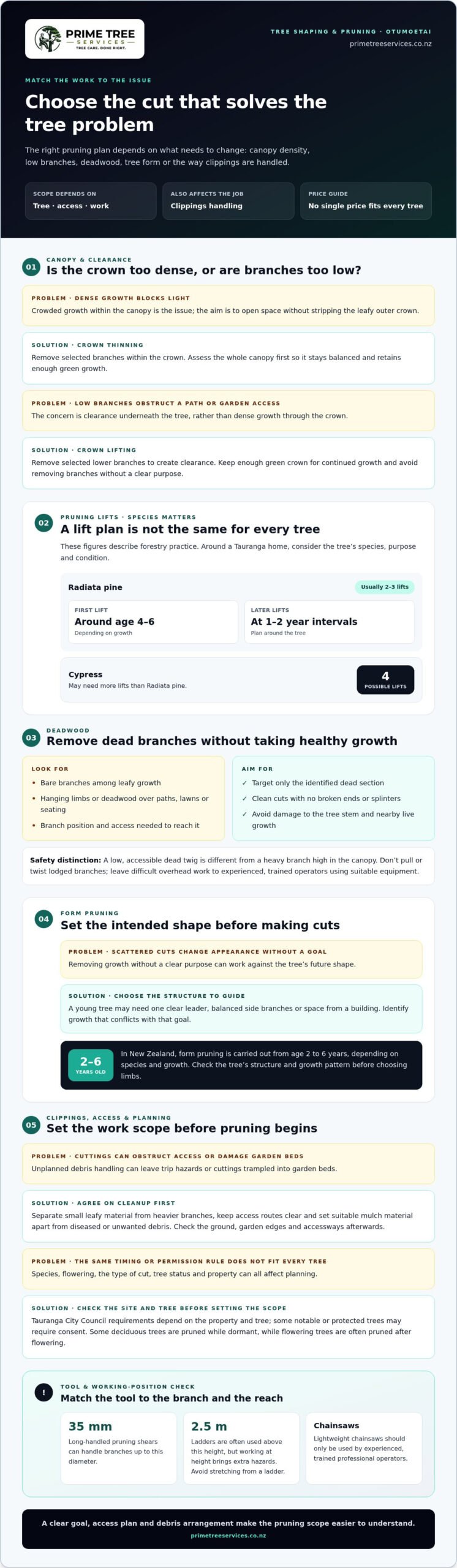
- Decide how to manage clippings before work begins. Separate small leafy material from heavier branches, and keep access routes clear as material is removed. This helps prevent trip hazards and cuttings being trampled into garden beds. If you want to keep suitable material for mulch, set it aside separately from diseased or unwanted debris.
- Match the tool to the branch and the working position. Long-handled pruning shears can handle branches up to 35 millimetres in diameter. For branches beyond reach, avoid stretching from a ladder; ladders are often used above 2.5 metres, but working at height brings extra hazards. Lightweight chainsaws should only be used by experienced, trained professional operators.
- Finish by checking the ground, garden edges and accessways for remaining debris. For a small shaping job, decide where the cuttings will go before making the cuts. Keep cuts close to the stem without damaging the branch collar. A clear cleanup plan helps leave the area usable and makes the work scope easier to understand.
Crown thinning and lifting
- Start by identifying the problem you want to solve. Thinning removes selected branches within the crown, while lifting removes lower branches to create clearance underneath. Choose thinning if dense growth blocks light through the canopy; choose lifting if low branches obstruct a path or garden access. A clear goal helps guide the work.
- Assess the whole crown before selecting branches. Remove carefully chosen growth to open space without leaving the tree lopsided or stripping its leafy outer canopy. A variable pruning lift leaves enough green crown for continued growth and can support tree vigour. Avoid removing branches just because they cross your view from a window.
- For Radiata pine, two or three pruning lifts are usually sufficient. The first lift is commonly carried out around age 4 to 6 years, depending on growth. Plan later lifts at 1 to 2 year intervals. These figures describe forestry practice, so use the tree’s species, purpose and condition to guide work around a Tauranga home.
- Consider the species before planning repeated cuts. Cypress may need four pruning lifts, while Radiata pine usually needs two or three. With a variable lift, the amount removed can differ between trees, while leaving each with enough green crown. This avoids treating every tree as if it needs the same cut or clearance.
- Finish by checking the result from several positions around the property. Confirm the crown remains balanced, lower branches clear the intended space, and retained foliage still forms a healthy-looking canopy. If you’re planning tree pruning and canopy care in Otumoetai, describe the access or light issue and the result you want. A clear brief helps shape the work around the site.
Deadwooding
- Begin with a ground-level inspection of the whole tree. Look for bare branches among leafy growth, hanging limbs and deadwood above paths, lawns or outdoor seating. Note their locations before work begins. In an Otumoetai garden, a branch over a driveway may require different access planning from one above an open lawn.
- Distinguish dead branches from live growth before choosing cuts. Compare bare branches with the surrounding foliage to help distinguish deadwood from live growth. Check each branch’s attachment and position in the crown. Marking what needs to go helps keep the work focused on deadwood rather than healthy limbs that shape the canopy.
- Work methodically from one identified branch to the next. Avoid removing live growth just to make the crown look evenly spaced. If a dead branch sits beside a healthy limb, for example, target only the dead section. This preserves the live canopy while removing unwanted wood.
- Make clean cuts, with no broken ends or splinters of wood or bark, and avoid damaging the tree stem. Ragged cuts can leave unnecessary wounds. Check each cut surface as you go, particularly where a dead branch joins a larger limb or the main stem.
- Choose a method suited to the branch’s position and size. A low, accessible dead twig is different from a heavy branch high in the canopy. Don’t pull or twist a lodged branch, as this can tear bark or damage nearby growth. Leave difficult overhead work to experienced, trained operators using suitable equipment.
- Finish by inspecting the crown and ground again. Look for overlooked deadwood, broken fragments and branches caught in nearby growth. Compare the tree with your initial notes, then check that the remaining cuts are clean and the stem is intact. A final pass helps leave the tree and surrounding garden orderly.
Form pruning
- Decide on the tree’s intended shape before making cuts. A young tree may need one clear leader, balanced side branches or space from a building. Set the goal, then identify growth that conflicts with it. This prevents scattered cuts that change the tree’s appearance without guiding its future form.
- Plan form pruning around the tree’s early growth. In New Zealand, it’s carried out from age 2 to 6 years, depending on species and growth. A young tree can be easier to guide than one with established competing branches. Check its structure and growth pattern before deciding which limbs need attention.
- Work from the trunk outwards, identifying the main stem and any competing leaders. If two upright stems compete, for example, decide which better supports the intended shape. Then consider side branches that crowd the structure. Make each cut for a clear reason rather than trying to create instant symmetry.
- Inspect the stem within the area being pruned. Remove cones, green shoots and green needles growing there, as they may develop into branches. Clearing them helps avoid new growth where a clear stem is desired. Recheck the whole section for anything missed among the remaining foliage.
- Keep the amount of live growth removed in line with the form you want. Removing too many branches at once can leave an unbalanced outline and reduce useful foliage. Pause after each cut and view the tree from the garden and nearby windows. This lets you assess the shape before making further changes.
- DIY pruning can lead to poor cuts, stem damage or falls, especially from ladders. Leave high branches and chainsaw work to experienced, trained professional operators; chainsaws used for pruning should only be handled by them. Choose an arborist when the work involves height, difficult access or branches that are unsafe to reach from the ground.
Prime Tree Services: Tree Removal & Felling
Prime Tree Services provides Tree Pruning & Canopy Care for trees that need deadwood cleared, improved clearance or a more balanced shape. If a tree’s condition or position means pruning won’t solve the problem, Tree Removal & Felling may be more appropriate for your Otumoetai property.
Describe the result you want, such as opening space above a path or removing a tree that no longer suits the property. This puts the work in context, including the tree, access and surrounding garden. Prime Tree Services also provides Hedge Cutting & Shaping and Shrub Pruning & Clearance.
To discuss tree work for your property, visit Prime Tree Services online.
Plan your next pruning job
Prepare a short job brief before arranging the work. Note which part of the garden needs more light or clearance, the shape you want and whether you’d like to keep or remove the clippings. This keeps the discussion focused on your desired result, rather than cuts without a clear purpose.
The price depends on the job and is provided after a quote request. Tree size, access, pruning scope and clippings handling all affect the work involved. Separate essential tasks from optional shaping so the priorities are clear.
For tree shaping and pruning in Otumoetai, Prime Tree Services provides Tree Pruning & Canopy Care, Tree Removal & Felling, and Hedge Cutting & Shaping. Choosing work to suit the property can help create a more open, orderly outdoor space.
A clear plan is a practical first step towards an outdoor space that’s ready to enjoy.
Frequently Asked Questions
Is pruning expensive?
Pruning costs depend on the work required, so a small, accessible job differs from complex canopy work. In Tauranga, the price is determined after a free site visit and provided as a written, fixed quote. To clarify the scope, separate essential work, such as clearing a problem branch, from optional shaping you’d like included.
What tree shaping and pruning services are available in Otumoetai, Tauranga?
Prime Tree Services provides tree care and removal for Otumoetai properties, including Tree Pruning & Canopy Care, Tree Reduction Service and Tree Removal & Felling. Other options include Hedge Cutting & Shaping, Shrub Pruning & Clearance, and Palm & Yucca Care and Removal. The right service depends on whether you need to maintain a tree, reshape its canopy or remove it.
How much does tree pruning cost in Otumoetai, Tauranga?
There’s no published price list for tree pruning in Otumoetai. The price is determined after a free site visit and provided as a written, fixed quote. This bases the quote on the actual tree and property, rather than a generic figure. Describe the work you’re considering, such as improving driveway clearance or reducing the canopy’s spread.
What factors affect the price of tree shaping and pruning in Otumoetai?
The quote reflects the tree’s size and condition, pruning scope, site access and how close branches are to buildings or other obstacles. Clipping removal can also affect the work involved. For a clearer assessment, note which trees need attention, the result you want and any access constraints, such as a narrow side passage or crowded garden.
What pruning methods are recommended for shaping trees without harming their health?
Use selective cuts that suit the tree’s natural structure rather than removing large sections indiscriminately. Make clean cuts without injuring the branch collar or stem, and retain enough healthy foliage to maintain the canopy. Tree topping is never performed. High branches and pruning chainsaw work should be left to experienced, trained professional operators, not attempted from a ladder.
What is the best season to prune common trees in Otumoetai, New Zealand?
There’s no single best season for all trees in Otumoetai. Some deciduous trees are pruned while dormant, while flowering trees are often pruned after flowering. The right timing depends on the species and the type of cut.