What if a truck or van could pass safely without stripping away more of a tree than needed? Branches reaching over an access way can snag taller vehicles, obstruct visibility or put nearby buildings and pedestrians at risk. It’s understandable to want a simple clearance height, but the right cuts depend on the vehicle route, branch position, tree structure and what’s around it. If you’re searching for “access way branch pruning tauranga”, a site-specific assessment is a sensible place to start.
This article explains what an assessment considers and how targeted pruning can improve access while taking the tree and nearby property into account. You’ll also learn what to prepare before arranging work, from the types of vehicles using the route to any tight spots around buildings or footpaths. Prime Tree Services can assess whether pruning or another tree-care approach suits your Tauranga site, helping you plan a safer, clearer way through without relying on a blanket cutting height.
Key Takeaways
- Access way branch pruning tauranga should focus on the branches affecting passage, rather than cutting back the whole canopy by default.
- Before arranging an assessment, note the vehicles using the route, when it gets busy and any nearby buildings, footpaths or other obstacles.
- Targeted pruning, tree reduction or removal may suit different access problems; the tree and site help determine the right approach.
- A site visit can clarify the scope of work and how to manage potential effects on the tree, vehicles and surrounding property.
Why access-way branch pruning matters on Tauranga sites
A branch dipping over a driveway, loading area or service lane can narrow the usable route, catch a taller vehicle or make a turn harder to judge. On industrial sites, that can disrupt deliveries and day-to-day movement. Access-way pruning is the targeted removal or trimming of branches that interfere with passage, while retaining the tree’s suitable form. It addresses specific access problems, rather than removing or reshaping an entire tree by default.
There’s no one clearance measurement that suits every site. The route’s shape, vehicles using it, branch position, tree condition and nearby buildings or other obstacles all affect what work may be appropriate. A site assessment helps identify the branches causing the problem and consider how to improve passage without cutting more canopy than needed. For an overview of the purposes and basic methods of pruning, see Wikipedia. Prime Tree Services provides tree trimming and pruning in Tauranga, with the scope guided by the site.
Which Tauranga access ways can be affected?
Branches can obstruct residential driveways, business yards and shared service lanes. The vehicles using each route matter: a delivery truck may need more room than a car, while regular traffic and turning movements can bring vehicles close to branches that look clear when the route is empty. Consider the whole path, including entrances, corners and loading areas.
Why not simply cut back every overhanging branch?
Cutting every branch above a route may remove more canopy than the access issue calls for. The tree’s health and branch structure, along with nearby buildings, vehicles and pedestrian areas, need to be considered before choosing cuts. Targeted access way branch pruning tauranga starts by identifying the specific obstruction, then matching the work to the tree and its surroundings. A broader reduction or removal may be considered if the site assessment shows that limited pruning isn’t suitable.
How an arborist assesses branches over an access way
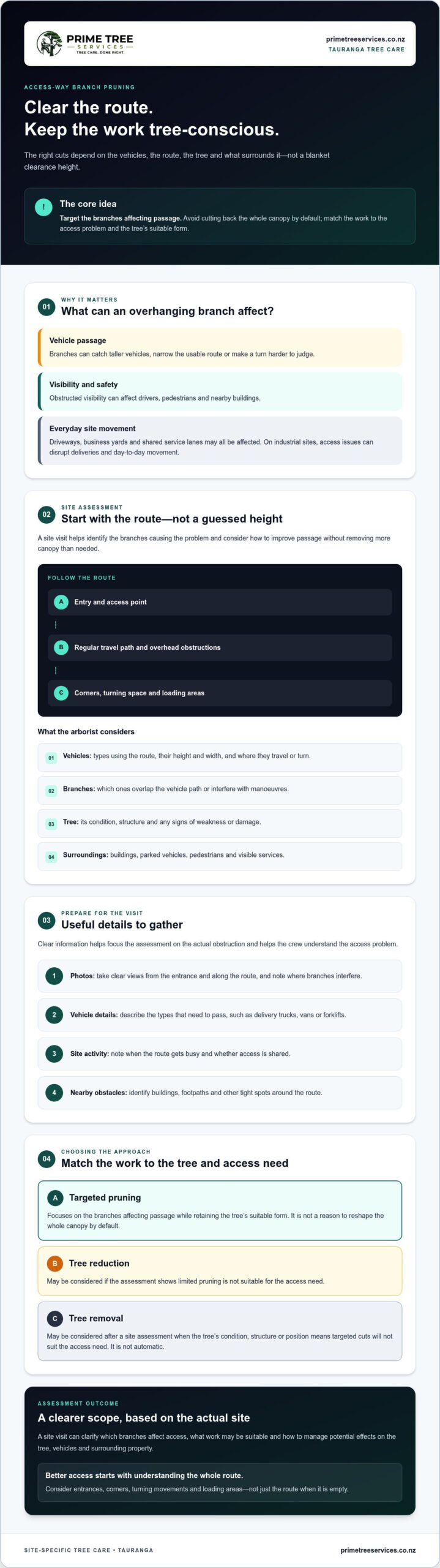
A useful assessment starts with the route, not a guessed clearance height. The arborist considers which vehicles use it, their height and width, where they travel and turn, and which branches overlap that path. They’ll also look at the tree’s condition and structure, plus nearby buildings, parked vehicles, pedestrians and visible services, so the work plan accounts for the whole site.
The pruning scope depends on the actual vehicle route and site conditions. The plan should name the branches affecting access and explain why they’re included, rather than treating the whole canopy as a problem. For a tree-conscious approach, the International Society of Arboriculture’s pruning best-practice guidance offers a useful professional reference.
What should the site assessment check?
Look at the entry, turning space, overhead obstructions and the parts of the route vehicles regularly use. A branch that clears a vehicle travelling straight may still interfere with a turn or loading manoeuvre. The assessor should also distinguish simple contact or obstruction from signs of weakness or damage, which may need closer attention before deciding what work is suitable.
When might pruning not be the whole answer?
If the tree’s condition, structure or position means targeted cuts won’t suit the access need, tree reduction or removal may be considered after assessing the site. Neither is automatic; the aim is to match the work to the tree and the route. For a site-specific view, explore Prime Tree Services’ tree trimming and pruning service in Tauranga.
For broader commercial decisions, the article’s linked guide, Commercial Tree Pruning Tauranga: A Business Buyer’s Guide, can help frame what to consider before choosing a scope. If you’re weighing up access way branch pruning tauranga for your site, start by describing the route and the vehicles that need to pass.
How to prepare a Tauranga site for access-way pruning
A little planning helps the tree-care crew understand the access problem and prepare for work around a busy site. Before requesting an assessment, gather details about the route, the vehicles that need to pass and what’s happening nearby. For access way branch pruning tauranga, clear information up front helps focus the discussion on the actual obstruction.
What information helps plan the work?
Share clear photos from the entrance and along the route, noting where branches interfere. Include the vehicle types involved, such as delivery trucks, vans or forklifts, and whether access is shared, used by customers or needed for regular deliveries.
- Describe the route: identify the entry, turning areas, narrow points and any restrictions.
- Explain when it’s busy: note delivery windows, shift changes or other periods with regular vehicle and pedestrian movement.
- Point out nearby features: mention buildings, parked vehicles, signs, fences and visible services close to the work area.
- Flag what you’ve noticed: distinguish branches that obstruct vehicles from any that look damaged or unstable.
How can you reduce disruption during pruning?
Agree site access, work timing and any temporary route changes with the tree-care crew before work begins. If trucks need to be redirected or a loading area kept clear, plan that with the crew and let affected staff, customers or neighbours know. Keep pedestrians and vehicles away from the active work area as agreed.
Don’t climb, cut or try to move hazardous branches yourself. Sharing photos and access details is a safer way to get the conversation started. If professional branch work is being considered, explore tree trimming and pruning services in Tauranga.
Choosing a safe, tree-conscious pruning solution in Tauranga
The right approach balances vehicle access with the tree’s condition and the surrounding site. Targeted pruning removes or trims selected branches that interfere with the route. It may suit a localised obstruction where the rest of the canopy doesn’t need changing. Broader tree reduction reshapes the canopy when access concerns extend beyond a few branches; removal may be considered if the tree’s condition or position makes other options unsuitable.
Pruning, reduction or removal: what is the difference?
These options have different scopes and effects. Pruning focuses on particular branches, while reduction changes the tree’s overall canopy size. Removal takes the tree down entirely. If a broader canopy change may be relevant, review Prime Tree Services’ tree reduction services. An on-site assessment is needed to decide what fits the tree and the access requirement.
Don’t assume a remote description or photo can confirm the right solution. Before agreeing to work, ask which branches are included, how vehicle and pedestrian access will be managed, and what needs to be cleared or restricted around the work area. If the tree is on council land, beside a public road or near utility assets, check current requirements with the relevant council or utility provider before work is arranged.
For access way branch pruning tauranga, Prime Tree Services can assess the site and outline suitable tree pruning, reduction or removal work based on what the route and tree need. A clear scope helps you plan the work without assuming more canopy needs to come down than necessary.
Plan a clearer route with the right tree-care approach
Good access-way work starts with the route and the tree, not a blanket cutting height. Share which vehicles need to pass, where branches cause difficulty and what surrounds the work area. That gives the arborist useful context to assess whether selective pruning is suitable or whether another approach should be considered.
For access way branch pruning tauranga, Prime Tree Services provides tree pruning and canopy care in Tauranga, with an on-site assessment to help determine what work may suit your property. A considered plan can address access while taking the tree’s structure and nearby buildings into account. The right scope depends on the site.
With a clear assessment and a practical plan, you can take the next step towards a safer, more usable access way while giving the tree and surrounding property due care.
Frequently Asked Questions
What is access-way branch pruning?
Access-way branch pruning is selective trimming or removal of branches that interfere with a driveway, loading area or other vehicle route. The aim is to improve passage while considering the tree’s structure, rather than cutting back the whole canopy by default. For access way branch pruning tauranga, the appropriate branches and scope depend on the actual route, vehicles and surrounding site.
Can branches be pruned to give trucks more clearance?
Yes, an arborist can assess whether selected branches can be pruned to improve truck access. They’ll consider the vehicle’s route and size, including turning movements, along with branch position, tree condition and nearby buildings or services. There isn’t one clearance measurement that suits every site, so don’t rely on a remote estimate to confirm the work required or the result.
How do I know whether a tree needs pruning or removal?
An on-site assessment helps determine whether the obstruction can be addressed by pruning, whether broader tree reduction is more suitable, or whether removal should be considered. The decision depends on the tree’s condition and structure, its position and the access requirement. Prime Tree Services provides tree pruning and canopy care in Tauranga and can assess which tree-care option may suit the site.
Is it safe to prune overhanging branches myself?
Don’t climb to reach overhanging branches or attempt to cut branches that are heavy, damaged, high above the ground or near buildings, vehicles or services. A cut branch can fall unpredictably, and working at height or near power lines carries serious risk. Keep clear of the area and arrange an assessment by a suitable tree-care professional if the branch may affect people or access.
Do I need council approval to prune branches in Tauranga?
It depends on where the tree is and its status. Tauranga City Council requires Asset Owner Approval for work on trees on council land, including pruning. For a tree on private property, check current council guidance if it may be protected or subject to site-specific controls. If branches are near utility assets or a road reserve, confirm any requirements with the relevant provider or council before arranging work.