What if the hardest part of caring for shared trees isn’t the pruning, but agreeing on what needs doing and who’ll follow it up? Body corporate tree care Tauranga committees can manage more calmly when decisions follow a clear, documented plan. Trees may need routine attention, careful reduction or removal, and choosing the right work takes more than a quick look from the ground.
It’s understandable to weigh safety against resident disruption, access and the use of shared outdoor areas. A repeatable process helps everyone stay informed and makes it easier to act before a concern is overlooked. This guide sets out a practical cycle for checking shared trees, recording issues and prioritising work. It also explains what to compare in arborist proposals, including the recommended work, access arrangements and how the job may affect residents and the grounds. That gives your committee a clearer basis for organising suitable tree care across your Tauranga property.
Key Takeaways
- Build a shared tree care plan so maintenance priorities, resident access and follow-up are clear.
- Use a tree’s condition and location to guide discussions about pruning, reduction or removal.
- Record observations, next actions, the person responsible and when each concern should be reviewed.
- For body corporate tree care tauranga, compare written arborist scopes and clarify access, resident communication and clean-up before arranging work.
Body corporate tree care in Tauranga: why a shared plan helps
Body corporate tree care Tauranga means planning and recording the maintenance of trees in shared outdoor areas, rather than dealing with each concern in isolation. A written plan gives the committee a common record of what’s been noticed, what needs attention and who will follow up. It also helps coordinate work around resident access, parking and the use of shared grounds.
A concern doesn’t automatically mean a tree needs to come down. Depending on its condition, position and effect on the property, suitable work may involve pruning, reduction or removal. The science of arboriculture covers the care and management of trees. An arborist can assess concerns that aren’t clear from a routine visual check.
Written records help committees make consistent decisions by showing what was observed, what action was agreed and when the concern should be reviewed.
Which shared areas should the committee include?
Start with common grounds, entrances, paths, parking areas and trees near buildings. Give each tree or concern a clear location, note visible issues and record practical access constraints, such as a narrow path or parking spaces that may need to remain clear during work. For tree pruning and canopy care in Tauranga, tree trimming and pruning services may be suitable when supported by a site assessment.
What should a tree care plan achieve?
A useful plan balances tree condition, safe access, residents’ use of the grounds and the appearance of the site. For example, a concern beside a well-used entrance may need a different priority from one in a less-accessed corner. Record why each item has its priority, so the committee can explain and review the decision.
Keep the plan practical. It helps organise observations and follow-up, but it isn’t a substitute for professional assessment when the tree’s condition or suitable work is uncertain.
Pruning, reduction, or removal: choosing the right tree work
Choose tree work based on the tree and its setting, not on the biggest tool or the quickest-looking option. A branch over a path may call for targeted pruning, while a tree that has outgrown its space may need a different assessment. Its condition, position, nearby buildings and shared access all affect what work may be suitable.
Pruning removes selected branches, reduction reshapes a tree, and removal takes the tree out entirely. Removal isn’t automatically the simplest answer. An arborist can assess the tree and site, then explain the options before the committee agrees on a scope of work.
When might pruning or canopy care be enough?
Pruning may address a specific issue, such as branches interfering with a path or parts of the canopy needing attention. The aim is targeted work, not an assumption that the whole tree needs cutting back. Check the proposed work against the concern recorded by the committee. For relevant Tauranga work, see tree trimming and pruning services.
When should a committee consider reduction or removal?
Reduction may be considered when reshaping the tree could better suit its location. Removal may be considered if the tree is unsuitable for the site. Neither outcome should be assumed before assessment. An arborist can consider the tree’s condition and surroundings, then outline whether tree reduction or controlled removal may be appropriate.
For body corporate tree care Tauranga, keep decisions grounded by asking what concern each proposed task addresses, what the work includes and how it may affect shared grounds. If you need help assessing pruning, reduction or removal options for your site, contact Prime Tree Services to discuss the work and request a quote.
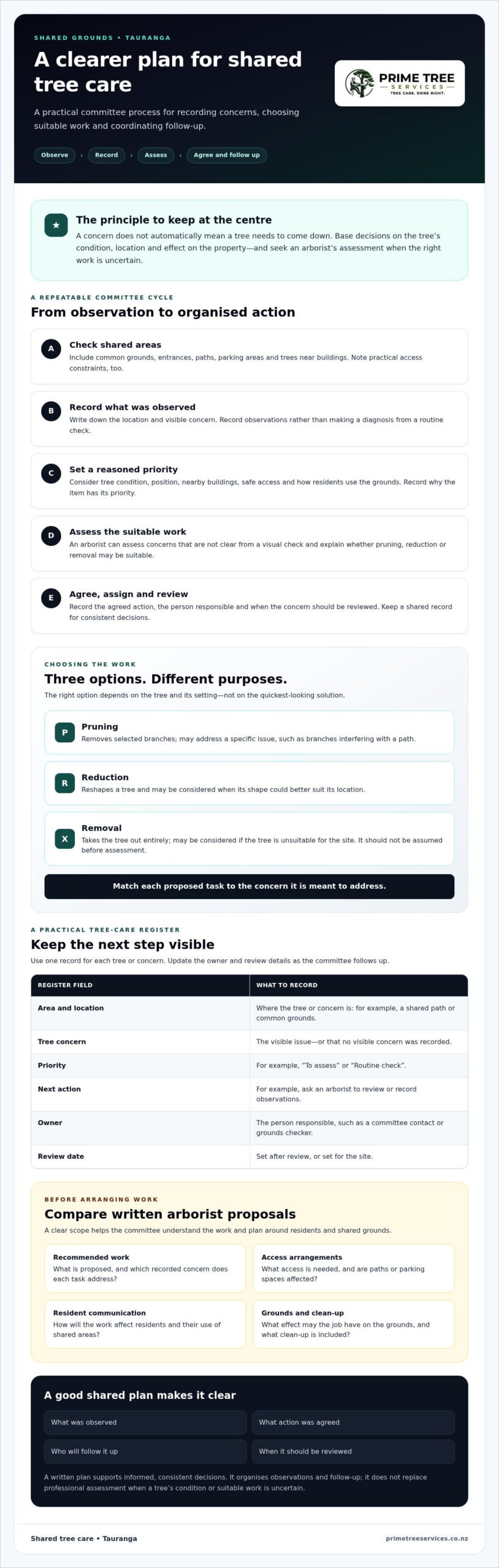
A Tauranga body corporate tree care schedule template
A simple register turns grounds checks into clear next steps. Use one row per tree or concern, and separate routine observations from items that need an arborist’s assessment. In a body corporate tree care tauranga plan, record what was seen rather than making a diagnosis. A committee member can note a branch near a building, for example, but shouldn’t decide from a checklist whether the tree is healthy.
| Area | Tree concern | Priority | Next action | Owner | Review date |
|---|---|---|---|---|---|
| Shared path | Branch appears close to accessway | To assess | Ask an arborist to review | Committee contact | Set after review |
| Common grounds | No visible concern recorded | Routine check | Record observations | Grounds checker | Set for site |
What to record during routine grounds checks
Note visible changes, branches near buildings or accessways, and reports from residents. Add the date, location and any access constraint, such as a narrow path or parking area that could affect planned work. If something is unclear, flag it for professional review rather than trying to diagnose the tree yourself.
How to prioritise and review the schedule
Sort entries according to the observed concern, the tree’s location and its effect on shared access. Confirm proposed priorities with an arborist. If vehicle routes are involved, include clearance needs in the assessment and work scope.
Use review dates as prompts, not as fixed arborist-approved intervals. Any suggested checking frequency is a starting point to confirm for the site. After work, record what was completed, update residents about arrangements, note any access changes and schedule a follow-up check where appropriate.
Choosing a Tauranga arborist and organising the work
A clear proposal makes it easier for a body corporate to compare like with like. Ask each Tauranga arborist to describe the recommended work, why it suits the tree and site, and what’s outside the scope. Check that the proposal also explains access arrangements, likely disruption to residents, protection of shared areas and how the site will be left tidy.
Before booking, confirm who can approve the work and who will update residents under your property’s own processes. This helps prevent decisions and practical arrangements from getting lost between the committee, property manager and contractor. If your shared grounds sit alongside commercial premises, a guide to commercial tree safety compliance in Tauranga may help you think through site coordination and safety responsibilities. For broader planning across shared grounds, the same clear scoping can support tree trimming and pruning work.
Questions to ask before approving a tree care proposal
Ask what work is proposed and what concern it addresses. If the recommendation is reduction or removal, ask why that approach is considered suitable and whether other options were assessed. Confirm what the scope excludes, how access will be managed, what residents need to know beforehand and what tidy-up is included. Clear answers make proposals easier to review and help avoid mismatched expectations.
Turning the plan into the next step
Before seeking advice, gather the tree’s location, your recorded observations, clear photos and any known access constraints, such as narrow routes or nearby parked vehicles. Share these details alongside the committee’s main concern. They help an arborist understand the setting and discuss work that fits the property, though an on-site assessment may still be needed.
For body corporate tree care tauranga, a written scope gives the committee something practical to review, approve through its own process and communicate to residents. Prime Tree Services provides pruning, canopy care, tree reduction and controlled tree removal in Tauranga. To discuss the site and request a quote, get in touch when it suits your committee.
Put a clear tree care plan into action
A practical approach to body corporate tree care tauranga starts with shared records, considered priorities and a suitable scope of work. Routine observations help the committee spot concerns, while an arborist can assess the tree and site before pruning, reduction or removal is agreed. Written proposals and resident updates help keep work organised and shared areas usable.
Prime Tree Services provides tree care across Tauranga, including pruning, canopy care, tree reduction and controlled removal. For removal work, the team uses specialised equipment and controlled techniques, taking the site into account as the work is planned.
Gather your notes, photos and access details, then discuss the work that may suit your property.
A steady plan makes the next decision easier, helping your committee care for shared grounds with confidence.
Frequently Asked Questions
How often should a body corporate arrange tree checks?
There’s no single interval that suits every Tauranga site. A committee can set a documented review routine and confirm its frequency with an arborist. Routine visual observations can record visible changes around shared grounds, but they’re different from a professional assessment of a tree’s condition. Arrange earlier attention if a change appears or residents report a concern. This keeps body corporate tree care Tauranga organised without treating one timetable as right for every property.
Does a body corporate need to remove a tree if it has overhanging branches?
No, overhanging branches don’t automatically mean a tree needs to be removed. Depending on the tree, its condition and the surrounding property, targeted pruning or reduction may be more suitable. Ask an arborist to assess the situation and explain the options before the work is scoped. The committee should also check its own approval process before arranging work, so the decision and resident communication are handled clearly.
What should a body corporate tree maintenance schedule include?
Record each tree’s location, visible observations, priority, proposed next action, responsible person and review date. Include resident updates, access arrangements and notes on completed work, so the committee can track what was agreed and what still needs follow-up. A schedule helps organise decisions, but it can’t diagnose tree health. Use the record to brief an arborist when a concern needs professional assessment.
How can a Tauranga body corporate compare tree care quotes?
Compare each written scope and recommended approach, along with access needs, likely disruption to residents and clean-up arrangements. Don’t rely on a headline figure alone. Ask providers to clarify what’s included and what may need separate approval, then check site-specific requirements with the property manager or body corporate. A clear comparison helps the committee understand what work is proposed before booking it.