Removing an entire shelterbelt may solve one problem and create another. If a row of trees is declining, shading an orchard or making access difficult, it’s understandable to consider clearing the space. But shelterbelts also help protect crops and property from wind, so complete removal isn’t always the right answer. With shelterbelt removal tauranga, the best option depends on the trees’ condition and what the site needs next.
This guide compares removal, height reduction and selective tree work to help you decide what suits your property. You’ll find signs a shelterbelt needs attention, reasons to retain some trees, and practical details to plan for, including machinery access, buildings, orchard rows and vegetation you want to keep. Prime Tree Services carries out controlled tree removal and felling in Tauranga using qualified arborist techniques and specialised equipment, with a plan tailored to the property.
Key Takeaways
- Match the work to the problem. Retaining, selectively removing or reducing trees can preserve useful shelter while improving the site.
- With shelterbelt removal tauranga, consider the trees’ condition, changing land use and the role you want any remaining shelter to play.
- Map access and work boundaries, noting nearby fences, buildings, driveways, neighbouring land and trees you want to keep.
- Describe the issue and the result you want, so the work plan reflects the shelterbelt’s condition and your property.
Shelterbelt removal in Tauranga: what problem are you trying to solve?
A shelterbelt is a planted row of trees that serves a purpose on a property, often helping to filter wind, mark a boundary or provide privacy. Around Tauranga, it may border orchard rows, paddocks, a driveway or a neighbouring block. Owners consider shelterbelt removal tauranga when trees are declining or dead, create concerns, require more upkeep than is practical, or no longer suit the way the land is used. A change to an orchard layout or plans for a cleared area can also prompt a closer look.
Shelterbelt removal means taking out some or all of a planted tree row to address its condition or make the land better suited to its intended use. The right scope depends on the site, and removal isn’t automatically the best answer for every tree. If the row is maintained more like a tall hedge, hedge removal in Tauranga may be a better description of the work. For general background on windbreaks and their role, see What is a Shelterbelt?
When does a shelterbelt become a property concern?
Look for signs such as dead trees, visible decline, broken or unstable-looking sections, or branches affecting buildings, fences and access. A row may also cast shade where light is needed or make orchard and property maintenance difficult. These signs are reasons to assess the trees and the wider site, not proof that every tree needs to come out. Depending on the condition and the issue, work may be limited to the affected trees.
What can change when a shelterbelt is removed?
Taking out a row changes tree cover and may alter shelter, light and the appearance of a boundary. Before deciding, consider adjoining land, nearby orchard use and whether the cleared strip will become access, growing space or another part of the property. A focused shelterbelt job is different from clearing an entire section. Defining the row and the intended work area keeps the plan centred on the trees that need attention.
Remove, reduce or retain: how to choose the right shelterbelt approach
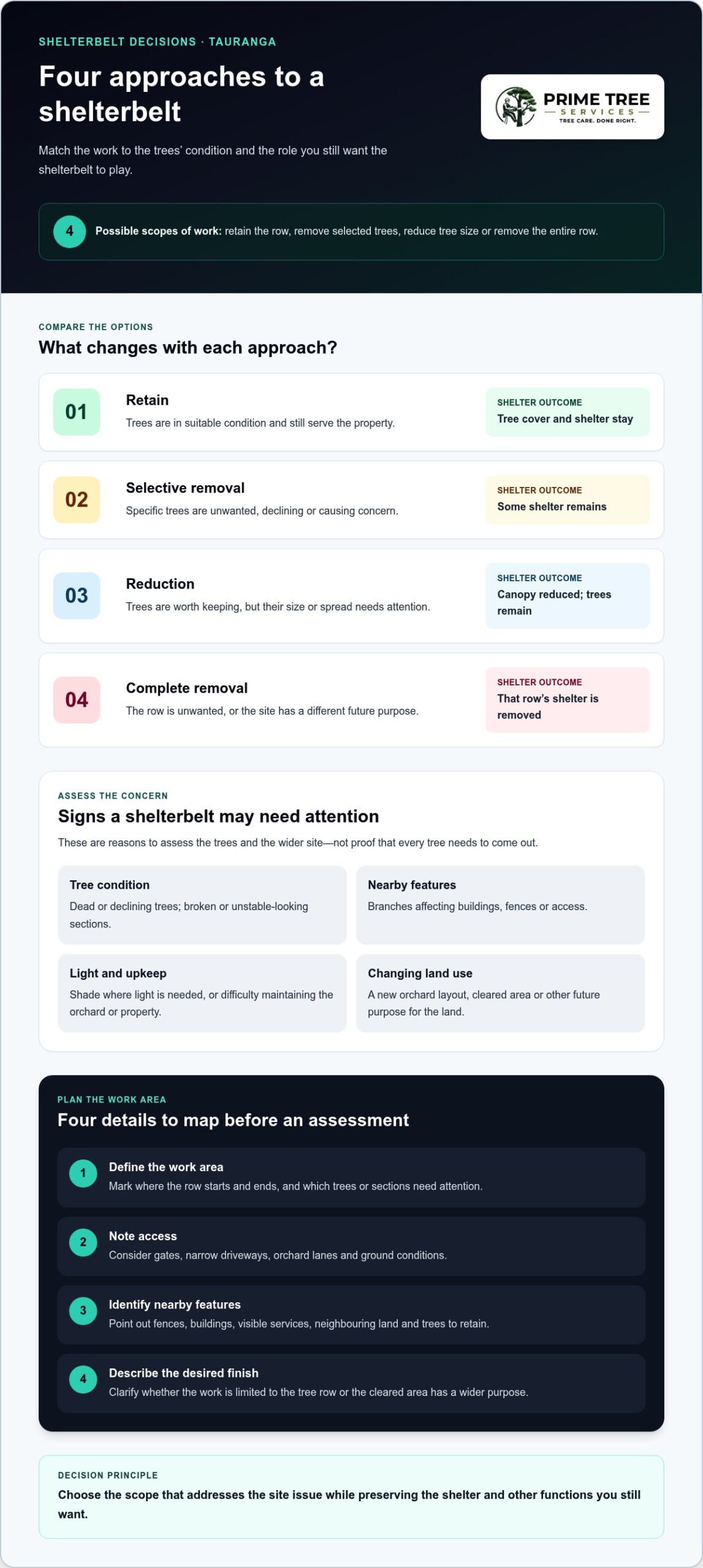
The choice depends on the trees’ condition and the job the shelterbelt still needs to do. A sound row may remain useful, while isolated problem trees or an oversized canopy may call for more targeted work. For shelterbelt removal tauranga, compare the outcome you want for the site with how much shelter you want to retain.
| Approach | May suit when | What changes |
|---|---|---|
| Retain | Trees are in suitable condition and still serve the property | Tree cover and shelter stay in place |
| Selective removal | Specific trees are unwanted, declining or causing concern | Some shelter remains from the retained trees |
| Reduction | Trees are worth keeping, but their size or spread needs attention | The canopy is reduced without removing the whole row |
| Complete removal | The row is unwanted or the site has a different future purpose | The tree cover and shelter from that row are removed |
When might selective work or reduction be enough?
If most of the row is in reasonable condition but a few trees are dead or unwanted, selective removal can address those sections while retaining the rest. Reduction is different: it changes a tree’s size or spread rather than removing it. If canopy size is the main issue, Prime Tree Services’ tree reduction service can reduce a mature tree’s height or spread while preserving its natural form. Match the work to the concern rather than assuming the whole shelterbelt needs to go.
When is complete removal the clearer option?
Taking out the full row may make sense when trees are unwanted, dead or hazardous, or when the land’s purpose has changed and the shelterbelt no longer fits. Consider the trade-off: clearing the row also removes its shelter and changes the site’s openness. Prime Tree Services carries out controlled tree felling and removal, with the planned scope set around the trees and property.
Decision rule: choose the scope that addresses the site issue while preserving the shelter and other functions you still want. To discuss the options for your property, talk through your shelterbelt plans with Prime Tree Services.
Planning shelterbelt removal in Tauranga: access, boundaries and site impacts
A clear plan identifies the exact tree row and the finish you want. Before an assessment, work through these points in order:
- Define the work area. Mark where the shelterbelt starts and ends, and identify the trees or sections that need attention.
- Note access. Consider how the crew can reach the row, including gates, narrow driveways, orchard lanes and ground conditions that may affect access.
- Identify nearby features. Point out fences, buildings, visible services, neighbouring land and trees you want retained.
- Discuss the desired finish. Clarify whether the work is limited to the tree row or whether the cleared area has a wider purpose.
What should Tauranga landowners note before an assessment?
Walk the length of the shelterbelt and note problem areas, boundary lines and access pinch points. A gate that looks wide enough from the road may lead to a tight turn, while a fence or orchard row can affect how the work is carried out. Flag nearby structures, visible services and vegetation you want to keep, so these details can inform the site-specific plan.
How can the job minimise disruption to the property?
Agreeing on the work area and access plan helps the crew organise the job around the property rather than treating the tree row in isolation. Site conditions guide the work methods and equipment used, as no single approach suits every property. Planning around retained trees, driveways and adjoining land makes care for the surrounding property a priority, although no work plan can promise zero impact.
Think ahead about how you want the space to look and function afterwards. If unwanted hedges or shrubs border the shelterbelt, Prime Tree Services also provides hedge removal and shrub clearance. A well-defined scope keeps shelterbelt removal Tauranga focused on the site’s needs and the finish you’re aiming for.
From shelterbelt decision to removal plan with a Tauranga arborist
Once you’ve decided what the shelterbelt needs, the next step is a plan shaped around the trees and the property. A useful discussion establishes the issue, your preferred outcome, access and the exact work boundaries. The scope can vary with the row’s condition, position and nearby property features, so a site-specific plan turns a general idea into clearly defined work. If the row is better described as an overgrown woody boundary, Prime Tree Services also provides a Tauranga hedge removal service.
What information helps shape a useful removal plan?
Share where the shelterbelt is, its approximate length and which trees or sections concern you. Explain how you intend to use the cleared space, whether that’s improving orchard access, opening up a boundary or making room for another purpose. Photos can help show the layout and visible concerns, while a site visit can clarify access and surrounding features. These are practical planning aids, alongside a site-specific assessment.
How does Prime Tree Services approach the work?
Prime Tree Services plans controlled tree removal around the shelterbelt’s condition, access and nearby property features. Qualified arborist techniques and specialised equipment help the team carry out the work with care and keep the property secure. The agreed scope identifies which trees are included and the outcome you’re aiming for, so retained trees and boundaries are accounted for in the plan.
A clear starting point helps everyone work towards the same result. For shelterbelt removal Tauranga landowners can plan around their property’s needs, share the site details and preferred outcome with Prime Tree Services.
Make a clear plan for your shelterbelt
Turn your decision into a practical brief: what needs attention, how you want to use the land and which trees or features must remain. That gives the work a clear purpose from the outset. For shelterbelt removal tauranga, Prime Tree Services can plan a site-specific approach, whether you need controlled tree removal or felling using qualified arborist techniques.
Serving Tauranga properties, the team plans tree work with care for surrounding features and works to keep the property secure. With the scope agreed, you can move towards a space that better suits your plans without removing more than the site needs.
Start with a straightforward conversation about your property and the result you’re after.
Frequently Asked Questions
How do I know whether my Tauranga shelterbelt needs removal or just trimming?
Trimming may suit a localised canopy or branch issue, while removal may be worth considering if trees are dead, declining or no longer serve the property. Consider whether the concern affects one or two trees or appears across the row, and whether the shelterbelt still provides useful cover. A site-specific assessment can help weigh up options for shelterbelt removal Tauranga without assuming the whole row needs to go.
Can I remove only part of a shelterbelt?
Yes, selective removal can be considered when particular trees are unwanted or causing concern but other parts of the row remain useful. For example, you might want to clear a section that conflicts with a new access route while retaining trees along the rest of the boundary. The plan should identify which trees will be removed and which will stay, so the intended limits are clear.
What should I consider before removing a shelterbelt on a Tauranga property?
Start with the future use of the land, then consider what the shelterbelt currently does for adjoining areas. In Tauranga, onshore winds from the northeast make wind direction worth considering, especially beside an orchard or exposed boundary. Think about whether removing the row could change how wind reaches those areas, as well as access for the work and the position of nearby fences, buildings and trees you plan to retain.
What happens to the land after a shelterbelt is removed?
The result depends on the agreed work and what you want to do with the space next. A cleared strip might become easier to access or form part of a changed land layout. If the remaining tree bases affect how you plan to use the area, include your intended ground finish in the work discussion. Clarify the desired result before the work is planned.
How is a shelterbelt removal quote worked out?
A quote is based on the particular trees, site and agreed scope, rather than a universal rate. The row’s length and condition matter, as do access constraints such as a narrow entrance, uneven ground or nearby structures that shape the work plan. Share which sections you want removed and what should remain. Photos can provide useful context, while a site discussion can clarify details that aren’t easy to see in an image.