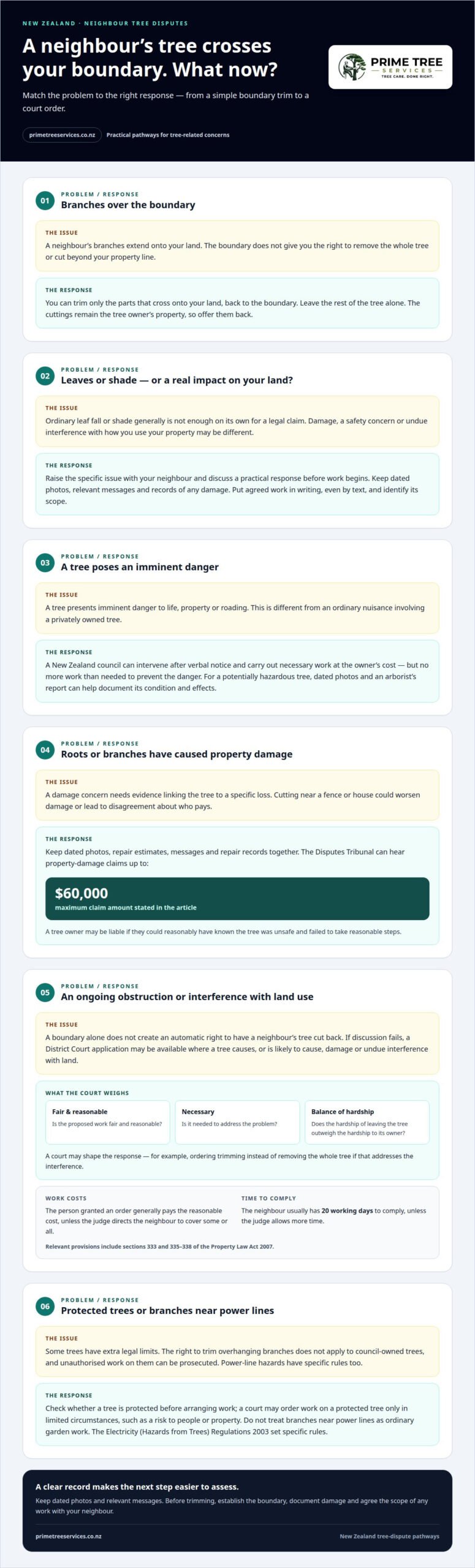
In New Zealand, you can trim a neighbour’s overhanging branches back to your property boundary, but not beyond it. For overhanging branches at the property line in NZ, this means cutting only the parts that cross onto your land and leaving the rest of the tree alone. The cuttings remain the tree owner’s property, so offer them back.
A neighbour’s tree reaching over your fence can be frustrating, but the right to trim to the boundary does not give you the right to remove the whole tree. This guide explains what you can do, what to consider before cutting, and when a District Court may order a neighbour to trim or remove a tree. It also covers the different rules for dangerous trees, damage and interference with your use of the property, so you can tell a routine boundary trim from a more serious dispute.
Key Takeaways
- Keep a record of tree-related damage or safety concerns, and put any agreed work in writing to avoid misunderstandings.
- Ordinary leaf fall and shade generally don’t create a legal claim; damage or undue interference with your land may be treated differently.
- A District Court weighs whether tree work is fair, reasonable and necessary, including the hardship to each neighbour.
- Before arranging a boundary trim, consider the tree’s stability and who owns the cuttings, especially if the work involves large or difficult branches.
District Court orders to trim or remove trees
A New Zealand council can intervene when a tree presents imminent danger to life, property or roading. After verbal notice, it may carry out necessary work at the owner’s cost, but no more than needed to prevent the danger. For ordinary nuisance from a privately owned tree, councils generally defer to the Property Law Act 2007 rather than controlling the dispute.
If a neighbour will not address a serious problem, the District Court may order trimming or removal. The order must be fair and reasonable, and necessary to prevent undue interference with another person’s use or enjoyment of their land. The court weighs the effect on the affected property against the hardship the work would cause the tree owner. Blocked sunlight or interference with property use may be relevant, while ordinary shade or leaf fall generally is not enough on its own.
The person granted an order generally pays the reasonable cost of the work, unless the judge directs the neighbour to cover some or all of it. The neighbour usually has 20 working days to comply, unless the judge allows more time. These rules appear in the Property Law Act 2007, including sections 333 and 337-338. A New Zealand District Court tree-removal case is reported as [2016] NZDC 9207.
Protected trees have an added limit. A court may be able to order work on a protected tree in limited circumstances if it poses a risk to people or property. Council rules may also protect particular trees, so don’t assume a boundary gives permission to prune a protected tree. The right to trim overhanging branches doesn’t apply to council-owned trees, and unauthorised work on them can be prosecuted.
Before seeking a court order, raise the concern with your neighbour in writing and keep dated photos. If the tree may be hazardous, an arborist’s report can help document its condition and effects. Put any agreed work in writing, even by text, so the boundary, scope and handling of cut material are clear.
Can I do anything about my neighbour’s tree?
Yes. Raise the specific problem with your neighbour and discuss a practical response before any work begins. Clear records help distinguish ordinary leaf fall from damage, obstruction or a safety concern.
Agreeing on tree work
An agreement records what work both neighbours accept and how it will be handled. This can prevent disputes about the boundary, the scope of work or responsibility for damage.
Describe the issue plainly, such as branches rubbing against a fence or blocking access. Put any agreement in writing, even by text, and identify the branches or area involved. This gives both neighbours a clear record if the plan changes or questions arise.
Costs, evidence and damage claims
Evidence links a tree problem to a specific loss, helping neighbours discuss responsibility and possible repairs. Keep dated photos of damage, repair estimates and relevant messages together. If roots or branches cause property damage, the Disputes Tribunal can hear claims up to $60,000.
Before arranging work on encroaching branches or roots, consider discussing the costs with your neighbour. The tree owner may be liable for damage if they could reasonably have known the tree was unsafe and failed to take reasonable steps. For example, records showing that a dangerous limb was reported may help establish what the owner knew.
Risks before trimming branches
Before trimming, establish the boundary, document any damage and agree on the work with your neighbour. Take particular care if branches affect a fence or house, as cutting could worsen the damage or lead to disagreement about who pays.
Power-line hazards are covered by the Electricity (Hazards from Trees) Regulations 2003, regulations 9-11 and 19-22. Don’t treat those branches as ordinary garden work. The regulations set specific rules for tree hazards near power lines.
Resolving tree disputes
Tree disputes may be addressed through discussion with your neighbour, a property-damage claim or, in suitable cases, an application to the District Court. The right approach depends on whether the issue is repair costs, an ongoing obstruction or a risk related to the tree.
For a damage claim, gather photos, dates, messages and repair records to show what happened and its effect. The Disputes Tribunal hears property-damage claims up to $60,000. If the concern is ongoing interference with land use, the Property Law Act 2007 provides a separate route to seek a court order.
Court orders under the Property Law Act 2007
The Property Law Act 2007 lets a District Court order a tree owner to trim or remove a tree causing, or likely to cause, damage or undue interference with another person’s land. This can apply when a tree affects ordinary use of a property, not simply because an owner dislikes its appearance. The Act does not create an automatic right to have a neighbour’s tree cut back. If discussion fails, an affected landowner can apply for a court order.
Under section 335, the judge must consider whether the proposed work is fair and reasonable, necessary to address the problem, and justified by the balance of hardship. The hardship of leaving the tree must outweigh the hardship the order would cause its owner. For example, evidence that roots are damaging drains could help show a practical effect on the land. The court assesses the problem and the consequences of trimming or removal, rather than relying on the boundary alone.
The Act’s provisions cover different circumstances. Section 332(b) concerns dangerous trees, while sections 335(1) and 336(2) address the court’s decision and the work ordered. Sections 337(1)-(2) set out further requirements for orders. Together, they allow the court to shape a response to the problem, such as trimming instead of removing the whole tree, where that addresses the interference.
Costs also matter. Under sections 333, 337 and 338, the person granted an order generally pays the reasonable cost of the work, unless the judge directs the neighbour to pay some or all. So an applicant should consider the likely work and its cost before taking the dispute to court. A court order is a specific remedy for serious interference or damage, not a way to make the neighbour pay for routine trimming or a preferred view.
Trimming overhanging branches to the fence line
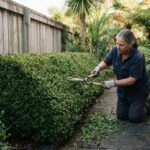
In New Zealand, you may cut a neighbour’s branches back to the boundary where they encroach onto your land. If the fence marks the boundary, the practical limit is the fence line. You may trim or remove the overhanging parts, but not branches growing on the neighbour’s side or the tree itself.
Keep the work to branches crossing onto your property. For example, if a branch reaches over the fence above your garden, you may cut the encroaching part back to the boundary. The same limit applies to a branch hanging over your gutter. Do not cut into your neighbour’s land, even if the trunk crosses the boundary.
Take care before cutting large branches or roots. Roots may be cut back, but work that undermines the tree’s stability or the surrounding ground can cause further problems. If the tree looks unsafe or branches are difficult to reach, document the concern and discuss the work with your neighbour before proceeding. Keep any agreement about the trimming in writing.
There is also a property distinction after the cut: fruit and cuttings remain the tree owner’s property. Offer the removed material back rather than assuming it is yours to keep or dispose of. If you arrange and pay for boundary trimming yourself, you cannot claim the cost from your neighbour. Agreeing beforehand can help avoid disputes over the branches or the bill.
The key point is that your right to trim ends at the boundary, not at the tree trunk or wherever a branch becomes inconvenient. Keep the work within that limit, preserve the rest of the neighbour’s tree and return the cuttings. If a gutter, fence or garden needs regular attention, discuss a practical trimming plan with your neighbour rather than repeatedly cutting without agreement.
Prime Tree Services: Tree Removal & Felling
Once the property issue has been addressed, Prime Tree Services can help with careful pruning or removal of a neighbour’s tree. Tree Pruning and Canopy Care can manage overgrowth within the agreed scope. If removal is appropriate, Tree Removal & Felling handles the tree itself, rather than a simple boundary trim.
For branches near a roof, fence or other property feature, professional tree work can help prevent a minor obstruction from causing further damage. Before work begins, make sure the neighbour’s agreement or any court order clearly sets out its scope. This keeps the practical work aligned with the decision about the tree.
To discuss tree work, visit Prime Tree Services online.
Set a clear plan for future tree work
A useful next step is to make a simple plan with your neighbour before branches reach the fence, roof or gutter. Agree on the area needing attention, how cuttings will be handled and how you will communicate if the tree creates a new concern. A written note keeps expectations clear and can help both households protect their outdoor spaces without turning routine maintenance into another disagreement.
A practical approach to overhanging branches at the property line in NZ can make future decisions easier. Keep the conversation focused on the specific effect on your property, and distinguish routine trimming from damage or safety concerns that need a different response. For larger or awkward jobs in Tauranga, Prime Tree Services offers Tree Pruning and Canopy Care and Tree Removal & Felling, with the work planned to the agreed scope.
Take the next step at a pace that works for your property, keeping the boundary and a good neighbourly relationship in view.
Frequently Asked Questions
Can I cut back branches or roots encroaching from my neighbour’s property?
Yes, you can generally cut encroaching branches back to your boundary, and roots may be cut back with care. Do not cut beyond your land or remove your neighbour’s tree. Root cutting can affect the tree’s stability or the surrounding ground, so consider the likely consequences first. You pay for trimming you arrange yourself and cannot recover that cost from your neighbour.
Can I pick overhanging fruit or flowers?
Overhanging fruit belongs to the tree owner, so do not treat it as yours to pick. Cuttings from a branch you remove also belong to the owner, so offer them back. Ask permission before taking flowers from a neighbour’s tree. If pruning is agreed, settle beforehand how fruit, flowers and cut material will be handled, especially where branches cross a shared fence.
There are council trees growing over my boundary; can I cut them?
No. The right to trim encroaching branches does not extend to council-owned trees, and unauthorised work can be prosecuted. A branch hanging over your garden does not change who owns the tree. If it drops debris, blocks access or appears hazardous, note the location and concern, then raise the issue with the council responsible for the tree rather than cutting it yourself.
What are the New Zealand rules for overhanging branches crossing a property boundary?
For overhanging branches at the property line in NZ, you may generally remove only the parts crossing onto your land, not the tree beyond the boundary. Cut material remains the tree owner’s property. Ordinary shade and leaf fall generally don’t create a legal claim. If a tree causes damage or undue interference with your land, the Property Law Act 2007 provides a separate route to seek a court order.
Can a neighbour in New Zealand trim branches overhanging their property line?
Yes. A neighbour may trim branches extending onto their land but must stop at the boundary. This does not permit cutting into the tree on the other side or felling it. Council-owned trees are different: the usual right to trim encroaching branches does not apply, and unauthorised work can be prosecuted. Take care, too, if cutting could undermine the tree’s stability.
How far can a neighbour cut back overhanging branches under NZ law?
For overhanging branches at the property line in NZ, the general limit is the legal boundary, which may not align exactly with a fence. A fence can sit inside one property, so do not rely on its position alone when deciding where to cut. The limit is the edge of the neighbour’s land, not a set distance from the trunk. Offer removed branches back to the tree owner.