A tree may need more room underneath without needing a smaller crown. A crown lifting service in The Lakes removes selected lower branches to create clearance over a driveway, footpath or lawn while preserving the tree’s overall shape. The goal is practical space and a balanced canopy, not simply cutting away as much as possible.
Low branches can obstruct access, limit visibility or make mowing awkward. But lifting the crown too far can leave a bare-looking trunk and make the tree appear top-heavy. The position and extent of the cuts matter.
This article explains how crown lifting supports clearance, safety and appearance, what an arborist considers before pruning, and what happens during the work. You’ll also learn how clear height is maintained as a tree grows, so you can understand what to expect from the process.
Key Takeaways
- Understand how removing selected lower branches creates useful clearance while keeping the tree’s shape in mind.
- See why the amount of crown lifted matters for the tree’s balance and appearance.
- Learn what an arborist considers during the work, including how much live canopy to remove in a season.
- Find out why clear height needs ongoing attention as the tree continues to grow.
Professional Tree Services 101: What is crown lifting?
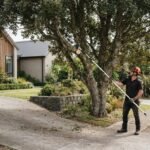
Crown lifting removes selected lower branches to create clearance beneath a tree. In The Lakes, this can open space over a driveway, footpath or lawn while preserving the upper canopy.
Clearance and light beneath trees
Crown lifting raises the lowest part of a tree’s canopy by removing lower branches, creating more room underneath. That clearance can make a driveway easier to use, keep branches from scraping a roof, or open a footpath for pedestrians. Removing low growth can also let more light reach a shaded garden bed, helping nearby plants grow and making mower access easier.
Crown lifting and crown thinning
Crown lifting removes lower branches to raise the canopy; crown thinning removes selected smaller branches within it. Thinning lets more light into the garden without changing the tree’s overall size or shape, while lifting changes the clear space beneath it. The distinction matters: if the issue is shade beneath a dense canopy, lifting alone may not address it. Crown reduction is different again, reducing height or spread while retaining the tree’s natural shape. The tree reduction service relates to that separate goal.
Factors affecting crown lifting prices
The price depends on the tree, site access and work needed to create the requested clearance. A broad canopy, branches close to a roof or restricted access can affect the work involved, as can the number and size of branches to remove. Prime Tree Services provides a free site visit and a written, fixed quote.
For protected trees, whether consent is needed in Tauranga or elsewhere in the Bay of Plenty depends on the tree’s status and the rules applying to its site. There isn’t one answer for every property. There’s also no single best season for lifting a crown: the tree’s condition, growth and reason for pruning all matter. Ask the arborist to explain which branches are proposed for removal, how the cuts will preserve the tree’s shape and how the planned clearance suits your driveway, path or garden.
Tree safety and structural balance
A crown lift changes where a tree carries its lower growth, so the remaining canopy needs to stay balanced. The arborist assesses the tree’s structure and considers whether other branches need attention. This matters when a low limb sits beside a roof, driveway or play area: clearance should not come at the expense of the tree’s shape and structure.
Excessive crown lifting can leave a tree with a bare trunk and a top-heavy appearance. Poor pruning can also remove too much canopy at once. Topping or cutting branches back to bare stubs can create decay points where new growth attaches. A considered lift uses selective cuts to remove lower branches while preserving a balanced outline. The appropriate cuts depend on the tree’s structure and the clearance needed.
Deadwooding addresses a different concern. It removes dead, dying or broken branches, including limbs above a house or play area. Such branches can fall without warning, so removing them can reduce a hazard and tidy the canopy. If a tree has both low branches and visible deadwood, the arborist can assess each issue separately instead of treating every branch as a clearance problem.
Crown thinning can also affect how a canopy handles wind: removing selected smaller inner branches lets air pass through more easily and reduces the canopy’s sail effect in a storm. Thinning aims for a lighter, even canopy, not a hollow centre. For a tree beside a Tauranga home, the work should account for its structure, the branches over nearby areas and the purpose of the pruning. Talk through tree safety concerns before deciding what work is appropriate.
Crown lifting process
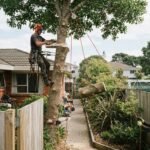
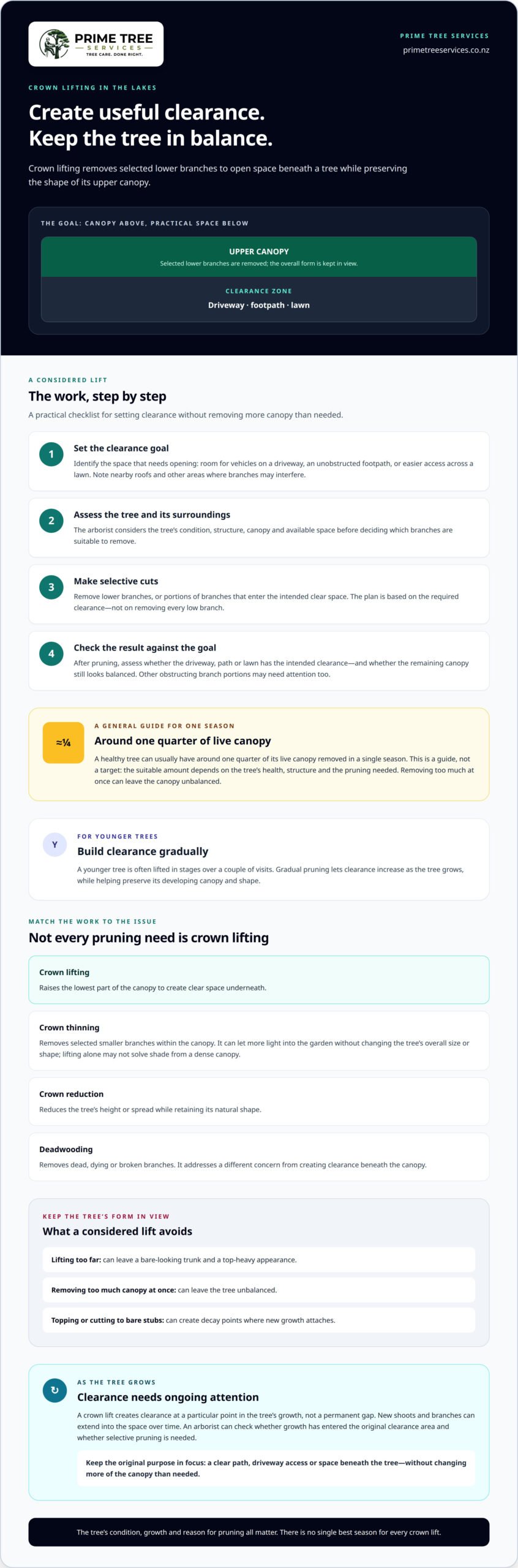
At a property in The Lakes, crown lifting starts by identifying the clear height needed beneath the tree. A driveway may need room for vehicles, while a footpath needs an unobstructed route. The arborist assesses the tree’s condition, canopy and surrounding space before planning the pruning.
The work is planned around the required clearance, not simply removing every low branch. It may involve removing lower branches and portions of other branches that obstruct the chosen clear height. This can keep a remaining limb out of the intended space while avoiding cuts that would unnecessarily change the tree’s shape.
The tree’s health and structure influence how much live growth can be removed. A healthy tree can usually have around one quarter of its live canopy removed in a single season. That is a general guide, not a target: the suitable amount depends on the tree and the pruning needed. Removing too much at once can leave the canopy unbalanced.
Younger trees are often lifted gradually over a couple of visits. Staged pruning lets clearance increase as the tree grows, rather than removing too many lower branches at once. For example, if a young tree needs more room above a path, the arborist can plan a gradual lift that preserves its developing canopy.
After the selected cuts, the result is assessed against the original goal: whether the driveway, path or lawn has the intended clearance and whether the remaining canopy looks balanced. Other obstructing branch portions may also need attention. The work should reflect the tree’s condition and the space beneath it, keeping both access and the tree’s form in view.
For a younger tree, gradual pruning is usually spread over a couple of visits. This allows each stage to respond to the tree’s developing shape and the clearance needed beneath it.
Maintaining clear height as a tree grows
A crown lift creates clearance at a particular point in the tree’s growth, not a permanent gap. New shoots and branches can extend into that space over time. Growth above a driveway may start to interfere with vehicles again; beside a path, branches can gradually obstruct people passing underneath. A crown lifting service in The Lakes can address changing clearance as part of ongoing tree care.
Maintenance focuses on the original purpose of the lift, such as keeping a path open or access beneath a tree clear. An arborist can assess whether new growth has entered that space and whether selective pruning is needed. The aim is to restore practical clearance without changing more of the canopy than necessary.
A tree’s shape can change too. A branch that once cleared a roof may spread sideways, while lower growth can alter the canopy’s outline. Reviewing both usable space and the tree’s form helps keep access clear without leaving the trunk bare. For example, a tree beside a Tauranga footpath needs to leave the route open while retaining a balanced shape.
Young trees can benefit from a gradual approach. Formative pruning can help avoid major pruning later, as growth shaped early may reduce the need to address large branches once they develop where clearance is needed. A crown lifting service in The Lakes can be planned with the tree’s structure and future space beneath it in mind.
There’s no fixed maintenance interval that suits every tree. Growth, required clearance and the tree’s condition all influence when further pruning may be appropriate. An assessment can compare current growth with the original access goal and identify branches needing attention. This keeps maintenance focused on the tree and its setting, not an arbitrary schedule.
Prime Tree Services
Prime Tree Services helps property owners address low, obstructive branches through Tree Pruning and Canopy Care. If a driveway, path or garden needs more clearance, we plan the work around the tree’s shape and the space you want to keep open. Our qualified arborists make selective cuts to suit the tree and the practical purpose of the pruning.
Before discussing the work, note which area needs clearance and how the branches affect its use. For example, mention whether growth hangs over a footpath, blocks access or shades a garden bed. These details help clarify the pruning request and the result you want.
Contact Prime Tree Services to discuss crown lifting for your property.
Plan the next step for your trees
Start with the space you want to keep clear and how you use it. A driveway, garden path and seating area each call for a different outcome. Describing the obstruction and the result you’re after gives the pruning conversation a practical starting point, without treating every low branch as a problem.
If you’re considering a crown lifting service in The Lakes, the next step is to consider the requested clearance alongside the tree’s shape and condition. Prime Tree Services provides Tree Pruning and Canopy Care, Tree Removal & Felling and Hedge Trimming and Pruning Services. The right work depends on the tree and how you need to use the surrounding space.
A clear goal helps keep the discussion focused on useful access and considered tree care. Share what the branches are affecting, then take the next step at a pace that suits your property.
Frequently Asked Questions
What is the process of a Tree Crown Lift?
A professional crown lift starts by establishing what needs to pass or fit beneath the tree. The arborist considers the requested clearance alongside the tree’s condition and shape, then plans selective cuts. For a young tree, the lift may be staged over a couple of visits, allowing the canopy to develop as clearance gradually increases.
What is crown lifting in tree care?
Crown lifting removes selected lower branches to raise the canopy’s lowest point and create usable space beneath a tree. It does not aim to reduce the tree’s overall height or spread. For example, it can open space beneath branches over a garden path. Crown thinning is different: it removes selected smaller branches within the canopy.
How much clearance should crown lifting provide over paths, driveways, and roads in New Zealand?
The required clearance depends on how the space is used, the tree’s shape and the branches involved. A garden path, driveway and road edge have different practical needs, so one clearance target will not suit all three. At a road edge, visibility for drivers and pedestrians also matters. The lift should address the specific route without unnecessarily removing the tree’s lower canopy.
What steps are involved in a professional crown lifting service?
The work generally follows a clear sequence: define the required clearance, assess the tree and surrounding space, plan suitable cuts, then remove the selected lower growth. The arborist may also consider branch portions that would still obstruct the intended height. For a younger tree, lifting can be gradual. The pruning plan should reflect both the access needed and the tree’s form.