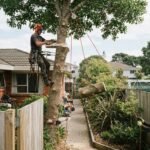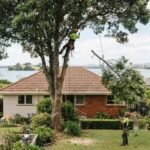
A tree does not need to be large to be difficult to remove. Difficult access tree felling in Papamoa may require climbing and controlled rigging when tight spaces, fences or nearby buildings limit equipment access. Instead of felling the whole tree at once, the crew can dismantle it in sections and lower them into a planned work area.
If the tree is close to a house, boundary or garden, it’s reasonable to want the work handled with care. The right approach depends on access, the tree’s position and what sits around it. This article explains how those factors shape the felling and removal plan, when climbing and rigging may be used, and what affects the work involved, so you can understand what to expect before arranging difficult-access tree work.
Key Takeaways
- Access routes and ground conditions help determine the safest way to reach and remove a tree.
- Climbing and rigging can allow sections to be lowered in a controlled way when there’s limited room to fell a tree whole.
- A careful work plan considers nearby buildings, gardens and smaller trees, not just the tree being removed.
- Tree size, position and surrounding hazards all shape how complex felling and removal will be.
Access across rough terrain and tight accessways
Difficult access tree felling in Papamoa means equipment cannot easily reach the tree. A narrow side passage, steep lawn, soft ground or steps can restrict access. For example, a tree behind a house may only be reachable through a gate beside the garage. The route matters because the crew needs room to move tools and cut sections safely.
Access planning starts at the entry point and follows the full route to the tree. The crew considers gate width, overhead branches, fences, retaining walls and ground firmness. A flat driveway offers different access options from a sloping section with garden beds. Wet or loose ground can also affect equipment movement and how cut material is handled.
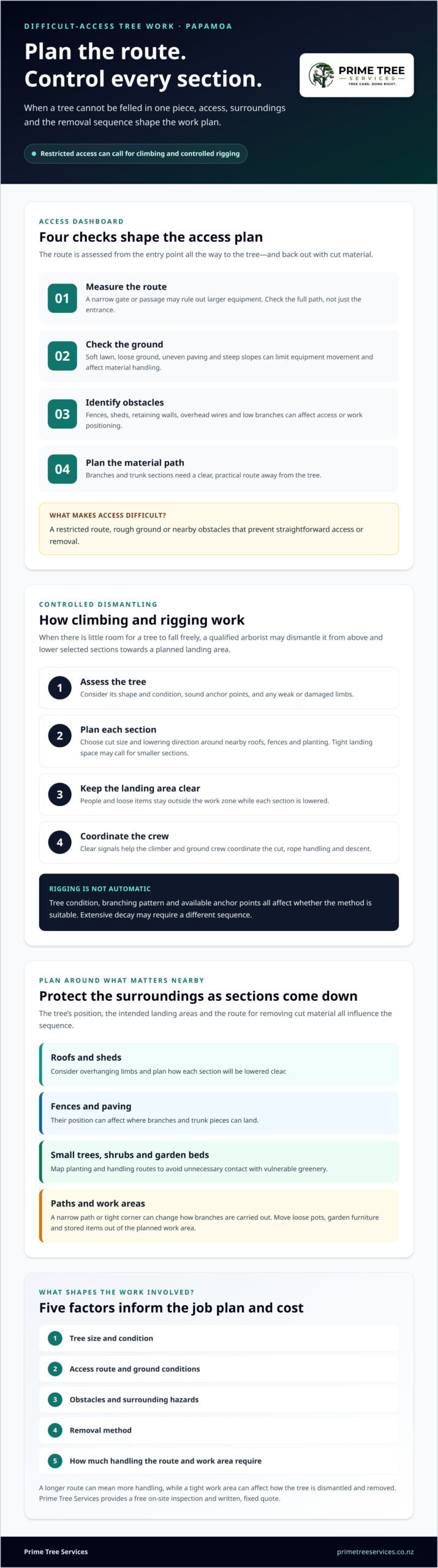
- Measure the route: a narrow gate or passage may rule out larger equipment.
- Check the ground: soft lawn, uneven paving and steep slopes can limit machinery movement.
- Identify obstacles: fences, sheds, overhead wires and low branches may affect access or work positioning.
- Plan the material path: branches and trunk sections need a clear route away from the tree.
What counts as difficult access tree felling in Papamoa? It is work where a restricted route, rough ground or nearby obstacles prevent straightforward access or removal. A tree behind a narrow side gate, for example, needs a different plan from one beside an open driveway.
The cost depends on the tree’s size and condition, access, ground conditions, obstacles and removal method. Prime Tree Services provides a free on-site inspection and written, fixed quote. A longer route can mean more handling, while a tight work area can affect how the tree is dismantled and removed. The crew assesses these factors together when planning the job.
Before work begins, the access plan should account for the tree’s position and the route out. This helps the crew decide where to work, how to move branches and logs, and whether equipment can reach the site. For restricted routes, tree felling and removal planning links access with the safest practical way to clear the tree and its cut material.
Climbing and rigging trees down safely
Where a tree cannot be felled in one piece, a qualified arborist may dismantle it from above. Controlled rigging lets the crew lower selected branches and trunk sections towards a planned landing area. This can suit a Papamoa backyard where a fence, roof or garden leaves little room for material to fall freely.
Before climbing, the crew assesses the tree’s shape, condition and surroundings. They consider which limbs can support the work, where selective cuts can begin and what lies below. A dead or damaged section may change the sequence, while a heavy limb over a shed needs a different lowering plan from a small branch over clear ground.
Each cut is part of a controlled sequence. The climber prepares a section for removal, while the ground crew manages the rope and guides its descent. Clear communication helps the team coordinate when a section is ready, where it should land and when the area must remain clear. If the landing space is tight, the crew may remove smaller sections.
- Assess the tree: identify sound anchor points and weak or damaged limbs before choosing a route.
- Plan each section: match the cut size and lowering direction to nearby roofs, fences and planting.
- Keep the landing area clear: move people and loose items outside the work zone.
- Coordinate the crew: use clear signals so cutting and rope handling happen in sequence.
Climbing and rigging are not automatic solutions for every restricted site. The tree’s condition, branching pattern and available anchor points all affect whether the method is suitable. For example, a narrow yard with a sound central trunk may allow planned section removal, while extensive decay can require a different sequence.
For a tree that needs dismantling above nearby structures, contact Prime Tree Services to discuss the work and its access constraints.
Protecting nearby property, greenery and small trees
A tree close to a roof, fence, driveway or garden bed may leave little room for branches to fall. Before work starts, the crew plans around the tree’s position and nearby features. A branch extending over a shed, for example, needs a different removal direction from one above open lawn. Smaller trees and established planting also affect where sections can be lowered and moved.
The work area is planned around the features to protect and the route for removing cut material. A fence may limit access, while a narrow garden path can restrict where branches are carried. The crew identifies landing areas, keeps the work zone clear and chooses a sequence that avoids dragging sections across vulnerable planting.
- Roofs and sheds: consider overhanging limbs and plan how each section will be lowered clear.
- Fences and paving: account for their position when choosing where branches and trunk pieces can land.
- Small trees and shrubs: map their location so removal routes avoid unnecessary contact.
- Garden beds: consider whether equipment or cut material needs to pass nearby.
For example, a tree beside a boundary fence and a row of young trees may need staged removal. The crew can remove larger branches first while keeping smaller planting outside the handling route. If a branch must be lowered close to a roof, its size and direction matter, as does the available space below.
Clear communication helps keep the work area orderly. The ground crew needs to know where sections are intended to land and which route must remain clear. Move loose pots, garden furniture and stored items out of the planned work area before work begins. This reduces obstacles and helps keep cut material away from delicate features.
Site conditions also affect how the work is planned. Soft ground near a garden bed may call for a different equipment route from firm paving, while a tight corner can change how branches are carried out. Considering the house, boundaries and greenery together helps the crew plan a tidy removal and site cleanup.
Tree felling and removal for large, difficult and dangerous trees
Tree size, condition and nearby buildings shape the removal plan. The sections below explain how the method, permissions, safety and site preparation affect the work.
Felling and removal methods
Standard felling suits a site with enough clear space for the tree to fall safely in a planned direction. Difficult access or nearby roofs may rule that out, making sectional dismantling more suitable. The crew removes branches and trunk sections in stages instead. The key considerations are the tree’s condition, available working space and where each section can be lowered or placed.
Permission and consent checks
Whether a tree can be removed without council permission or resource consent depends on the site and applicable planning controls. Tauranga City Council rules may apply in Papamoa, so check the tree’s status and property controls before work starts. Protected-tree schedules or heritage provisions may affect removal. A tree’s size or awkward position alone does not establish whether consent is needed.
Safety risks and insurance
Falling branches, unstable timber, climbing and nearby powerlines can create serious hazards. Before hiring a tree feller, ask how the crew will control the work area and manage sections near buildings or boundaries. Request written evidence of relevant insurance, then check its scope, exclusions and cover for property damage. Keep people and pets away from the marked work zone during felling.
Quotes and property preparation
For a quote, provide the property location, tree position, access constraints and nearby structures. Photos can show the tree and route to it, while an on-site assessment can reveal ground or overhead obstacles. Before work, clear movable items from the planned work area and agree on access and removal scope. Ask whether the quote includes taking away cut material, site cleanup and stump removal. Felling leaves the stump; its removal is a separate part of the agreed scope.
Prime Tree Services: Tree Removal & Felling
Prime Tree Services provides Tree Removal & Felling for Papamoa property owners who need a tree removed from a confined or challenging site. If a house, fence, garden or restricted accessway affects the work, share those details when discussing the job. They help the qualified arborists plan around the tree and its surroundings.
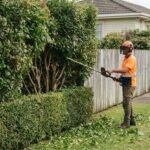
Tree removal may not be the only option. If the tree can remain, Tree Pruning & Canopy Care can address overgrowth, while hedge or shrub services can help clear nearby areas. The right work depends on what needs attention across your property.
For difficult access tree work in Papamoa, contact Prime Tree Services to discuss your tree and site.
Plan the next step for your Papamoa property
Consider how you want to use the space once the work is complete. You may want more light over a patio, clearer access beside the house or room to use a garden bed again. That goal helps guide the discussion, especially if you are weighing removal against retaining the tree and managing its canopy.
For difficult access tree felling in Papamoa, Prime Tree Services provides Tree Removal & Felling. If retaining the tree better suits your plans, Tree Pruning & Canopy Care may help manage its growth. Hedge Cutting & Shaping can also tidy overgrown boundaries and make the surrounding outdoor space more usable.
Share what you want to change and the features around the tree. A clear starting point makes it easier to discuss the work that fits your property.
With a practical plan in place, your outdoor space can feel more open, cared for and ready to enjoy.
Frequently Asked Questions
Which arborists offer difficult-access tree felling in Papamoa and Tauranga?
Prime Tree Services provides Tree Removal & Felling for property owners in Tauranga, including Papamoa. For difficult access tree felling in Papamoa, the property layout and tree condition help determine the work plan. Details such as nearby powerlines, shared boundaries or a narrow driveway are useful to share when discussing the job, as they can affect access and safe working arrangements.
What methods are used to fell trees with difficult access, such as climbing or crane removal?
Climbing with controlled rigging can allow the crew to dismantle a tree in sections where a whole-tree fall is not practical. A crane may be considered when lifting access, ground conditions and nearby obstacles make it suitable, but it is not needed for every site. The tree’s condition, available working space and position relative to buildings help determine the method and equipment.
How are tree waste, stump removal, and site cleanup handled after felling in Papamoa?
The written, fixed quote sets out the agreed work, including removal of cut material and site cleanup. Felling leaves the stump, so stump grinding is a separate service.