Hedge trimming cost in NZ depends on the hedge and the work required. Some providers charge by the hour, while others quote a fixed price for an agreed job. An hourly rate ties the bill to time on site; a fixed quote sets out the scope and total price upfront.
It is sensible to want a clear figure before work begins. Hedge height, length and condition affect the job, as do access and the amount of green waste to handle.
This guide explains how hourly charging compares with fixed job quotes, what can push the cost up, and how Tauranga pricing is commonly presented. You will also see when regular light trimming can help keep a hedge manageable, and when a larger reduction calls for more careful planning.
Key Takeaways
- Hourly charging can suit work that’s difficult to scope in advance, while a fixed quote can make the agreed job total clearer.
- Compare Auckland price ranges by hedge height and condition to get a better sense of how the work may be priced.
- Account for access, green-waste handling and the amount of cutting needed when weighing up a quote.
- Regular light trims can help keep growth manageable; a tall or heavily overgrown hedge may need a more involved approach.
How Much Does Hedge Trimming Cost in Auckland?
Hedge trimming costs in Tauranga depend on the hedge’s size and the work required. A low, regularly shaped hedge is a different job from a tall boundary hedge or one that has spread beyond its intended shape. Height, length, condition, access and green-waste handling all affect the scope. A site visit and written quote give you the price for the specific work.
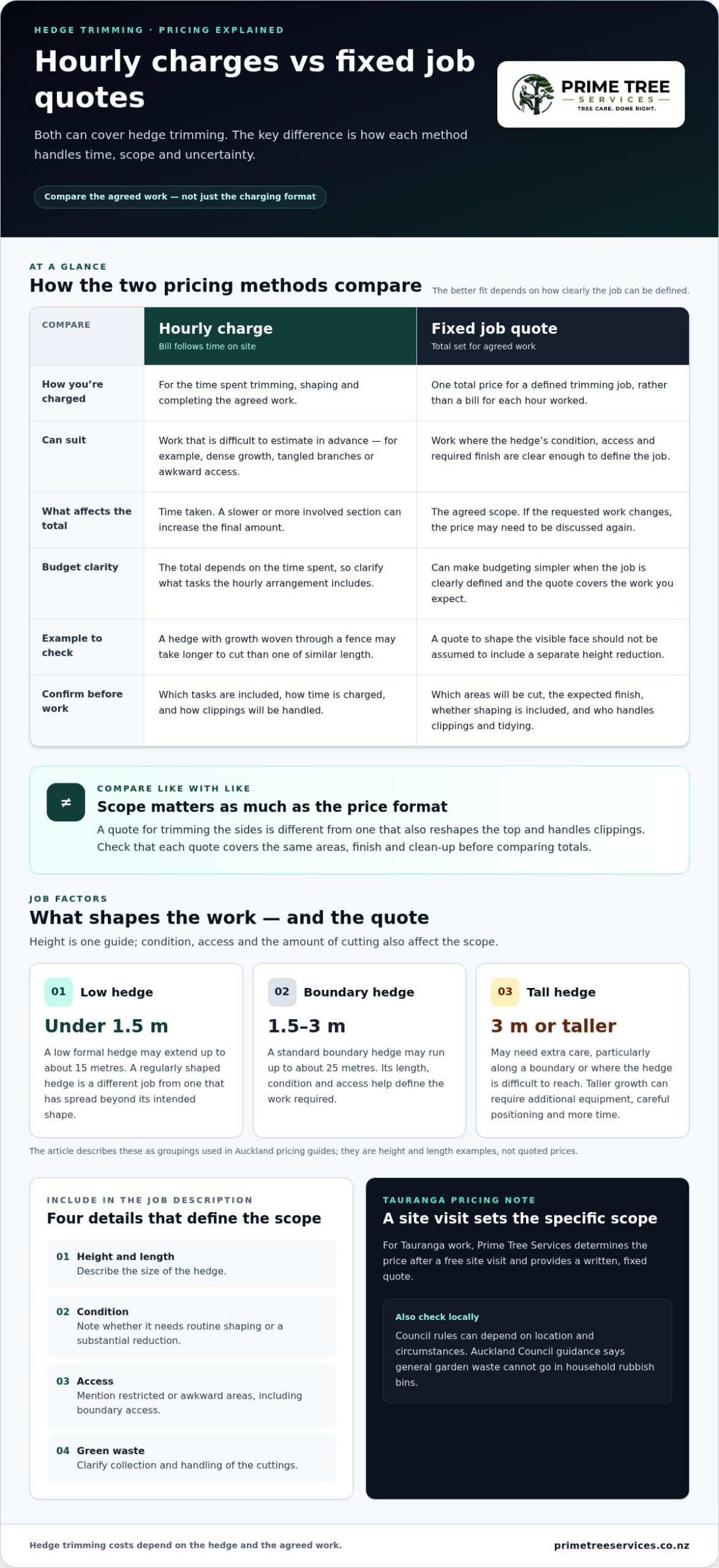
Height helps explain why jobs can vary. Auckland pricing guides group low hedges under 1.5 metres separately from standard boundary hedges between 1.5 and 3 metres. A hedge 3 metres or taller may need extra care, particularly if it runs along a boundary or has become difficult to reach. Length matters too: a low formal hedge may extend up to about 15 metres, while a standard boundary hedge may run up to about 25 metres.
Condition changes the scope. A tidy hedge that needs its usual shape restored is different from one requiring a substantial reduction. If growth has spread sideways or upwards, more material may need to be cut and handled. The quote should reflect the hedge and agreed work, not height alone.
New Zealand councils can have local rules affecting hedge height, boundaries or overhanging branches, so requirements depend on the location and circumstances. Don’t assume one nationwide height limit applies to every property; Auckland Council guidance also says general garden waste cannot go in household rubbish bins.
Before comparing quotes, describe the hedge’s height, length, condition and access, and clarify how cuttings will be handled. Those details define the job and make quotes easier to compare. A long, overgrown boundary hedge with restricted access involves different work from a short, maintained hedge beside an open garden. Clear scope matters as much as measurements.
Do hedge trimmers charge by the hour?
Some hedge-trimming jobs are charged by the hour, while others receive a fixed quote. Hourly charging ties the bill to time on site; a fixed quote covers an agreed scope. A small, accessible hedge may be straightforward to assess, while tangled growth or awkward access can make the work harder to estimate.
DIY trimming avoids paying for professional labour, but equipment and cleanup still have costs. If you already own a suitable trimmer, the main expenses may be upkeep and green-waste handling. Buying or hiring equipment adds to the cost, and a petrol model also needs fuel. The hedge’s length, density and shape determine how much time cutting and clearing takes.
- Equipment: Factor in a trimmer, extension lead for a corded model, or fuel and maintenance for a petrol tool.
- Protective gear: Use eye protection, sturdy footwear and gloves to reduce exposure to flying clippings and sharp branches.
- Green waste: Plan how to collect and dispose of cuttings, rather than leaving piles beside the hedge.
Safety should shape the decision, not just the choice of tool. Before cutting, clear people, pets and loose items from the work area. Keep both feet on stable ground and don’t stretch to reach the top. A tall hedge requiring ladder work, or branches close to power lines, raises the risk. Stop rather than cutting from an unstable position or reaching towards electrical wires.
Hourly charging can suit a job where the time needed is difficult to estimate. Ask what the hourly arrangement includes, such as trimming, shaping and collecting clippings. A fixed quote can make budgeting easier when the hedge and scope are clear. For Tauranga work, Prime Tree Services determines the price after a free site visit and provides a written, fixed quote.
If you’d rather leave the cutting to a crew, request a hedge-trimming quote for your property.
Hourly charges versus fixed job quotes
Both pricing methods can cover hedge trimming, but they handle uncertainty differently. The better fit depends on how clearly the work can be defined before it starts.
Hourly charges
An hourly charge bills for the time spent trimming, shaping and completing the agreed work. It can suit a hedge where dense growth, awkward access or tangled branches make the job duration hard to estimate. The final amount depends on the time taken, so a slower section can affect the total. Before work begins, clarify which tasks are included and how clippings will be handled.
For example, a straightforward hedge may take less time than one of similar length with growth woven through a fence. With hourly charging, that extra cutting time matters directly. A clear description of the work helps you understand what the time covers.
Fixed job quotes
A fixed quote sets a total for a defined trimming job rather than billing for each hour worked. It can make budgeting simpler when the hedge’s condition, access and required finish are clear. The agreed scope matters: trimming the sides differs from reshaping the top and handling clippings. If the requested work changes, the price may need to be discussed again.
For instance, a quote for shaping the visible face of a hedge shouldn’t be assumed to cover a separate reduction in height. Confirm which areas will be cut and the expected finish so everyone understands the job.
Compare like with like. An hourly rate may seem easier to assess, but the total depends on time. A fixed quote is useful only if it covers the same tasks. Check whether shaping, handling clippings and tidying the work area are included. These details can make quotes for the same hedge differ in scope.
A small, regularly maintained hedge with open access may be easier to define than an overgrown hedge behind a shed. If the hedge’s condition or required finish is unclear, describe the job carefully before agreeing to either pricing method. That gives you a better basis for comparing the work, not just the charging format.
How height and overgrowth affect cost
A hedge’s height changes how easily the trimmer can reach its sides and top. A maintained hedge below 1.5 metres is different from a boundary hedge at 3 metres or taller. Taller growth can require additional equipment, careful positioning and more time, particularly where access is restricted. The amount cut back also matters: light shaping removes less material than a major reduction.
For common New Zealand hedges, trimming frequency depends on growth rate and the shape you want to maintain. In Auckland, scheduling two or three light trims a year can help keep growth manageable and reduce the chance of a heavy cutback. Regular visits spread the work across smaller trims, while long gaps can leave thicker growth and more clippings to clear.
Overgrowth adds work beyond cutting the visible surface. A hedge that has widened into a path or grown above its intended height may need substantial reshaping. The work involves assessing how much can be removed while retaining a suitable shape, then gathering and handling the extra cuttings. Restricted access can make each part slower.
Consider an Auckland griselinia boundary hedge measuring 20 metres. Left for three years, it may reach about 3 metres tall and become a metre wider on each side. Reducing it means dealing with height, extra width and substantial growth, rather than simply tidying the outer surface.
A large reduction may need careful staging. Auckland contractors may spread the work over two seasons to encourage the hedge to reshoot instead of die back. A second visit the following season may be needed to finish shaping it. That can affect the overall scope, so discuss the intended finish and timing when defining the job.
Keep growth in check with light trims before the hedge becomes difficult to reach or shape. Describe its height, length, width and condition when arranging a quote; these details help explain the work involved. For an Auckland hedge that has outgrown its space, a clear assessment can distinguish routine trimming from staged reduction.
Prime Tree Services: Tree Removal & Felling
Prime Tree Services provides Hedge Cutting & Shaping for maintaining and shaping hedge growth, as well as Hedge Removal Service when a hedge needs to go completely. A site visit helps define the work, whether you need regular trimming or a more substantial change.
If nearby trees also need attention, Tree Pruning & Canopy Care can help manage their shape and spread. Tree Removal & Felling is a separate service for larger tree work. Matching the service to the plants and the result you want helps keep the scope clear.
When discussing the job, share what needs trimming or removing and mention any access concerns. Contact Prime Tree Services for a free site visit and a written, fixed quote.
Plan the right result for your hedge
First decide what you want the hedge to do: restore a tidy boundary, open up light or make room around a path. That gives the work a clear purpose rather than treating every cut as routine maintenance. When comparing hedge trimming cost in NZ, focus on the finished result and agreed scope, not just the charging method.
Prime Tree Services provides Hedge Cutting & Shaping to manage hedge growth. If trees also need attention, Tree Pruning & Canopy Care and Tree Removal & Felling address those separate needs. Keeping each task clear helps define the work and understand what the quote covers.
Share the result you want and the parts of your Tauranga property that need attention. A clear conversation can help turn an unruly outdoor space into a neater, more usable part of your home.
With a clear plan, your hedge can have room to grow neatly again.
Frequently Asked Questions
Does hedge trimming include green waste removal?
It depends on the agreed work, so check whether collecting and removing clippings is included in the quote. In Tauranga, Prime Tree Services says its sites are left tidy, with debris chipped, raked and swept before departure. For Auckland households, Auckland Council guidance says general garden waste cannot go in household rubbish bins, so plan disposal as part of the job.
How much does it cost to trim a tall hedge?
A tall hedge can take more work to reach and shape, and may produce more cuttings to handle. Height, length, thickness, access and the amount to remove all affect the scope. A hedge beside a fence may be harder to reach than one with open access. In Tauranga, Prime Tree Services determines the price after a free site visit and provides a written, fixed quote.
Is it cheaper to trim a hedge yourself?
Doing the work yourself can avoid paying for professional labour, but it isn’t automatically cheaper overall. The calculation changes if you need to buy or hire a trimmer, protective gear or equipment to reach the top. Include the time needed to cut and clear clippings. For a tall hedge or one near overhead lines, the safety risks can make DIY a poor trade-off.
Why do hedge trimming quotes vary so much?
Quotes can differ because the job descriptions differ. One may cover a light face trim, while another includes shaping the top, cutting back thick growth and handling clippings. Access also affects the work: a hedge behind a garden shed can take more effort than one beside a clear path. Compare the stated tasks and finish, not just the total or charging method.
What is the average cost to trim a hedge in New Zealand?
There isn’t one reliable figure for every New Zealand hedge: hedge trimming cost in NZ depends on the job and location. A national average can hide differences in size, access and condition. For Tauranga work, Prime Tree Services determines the price after a free site visit and provides a written, fixed quote, making the amount specific to your property.
How much do hedge trimming services charge per metre in NZ?
A per-metre figure can help compare quotes, but it doesn’t capture every part of hedge trimming cost in NZ. Two hedges of equal length may need different work because of their height, width, density, access or the amount of material to remove. A maintained hedge with a simple outline differs from one needing major reshaping. Share measurements and the hedge’s condition to define the scope.