Tree-felling costs in The Lakes depend on the tree and the work needed, not a single standard rate. To understand how much for tree felling in The Lakes, consider the tree’s size, access to the site, nearby buildings and what needs clearing afterwards. The price is set after a quote request, with these site conditions shaping the assessment.
It’s sensible to look beyond the main tree, too. Smaller trees and growth nearby can affect access, the work area and how neatly the site can be left, so planning ahead helps you avoid surprises on the day.
This guide explains how to prepare the area, assess smaller trees around the work site and understand the factors that influence a felling quote. You’ll have a clearer picture of what to consider before the work begins, helping the job proceed with less disruption to your property.
Key Takeaways
- Prepare the work area by noting obstacles, access routes and nearby growth before felling is planned.
- See how site access, buildings and the tree’s condition can shape the work involved and the quote.
- Understand why checking Tauranga council requirements is an important part of planning tree removal.
- Learn when professional tree felling or care for surrounding trees and shrubs can help leave the property safer and tidier.
Preparing for tree felling
In Tauranga, owning the property doesn’t automatically mean a tree can be felled. Check for protection rules or consent requirements first. Before any DIY cutting, consider falling branches, nearby hazards and your insurance cover. Chainsaw mistakes can cause serious harm or property damage.
- Mark the work area before deciding what to remove. Walk the ground and identify fences, garden beds, parked vehicles, sheds and overhead lines. Note where branches could land and where people might pass. Mark nearby trees and shrubs too, distinguishing those to retain from those included in the work. Keep children and pets away from the work zone.
-
Confirm permits and council rules
Check Tauranga City Council’s planning and property information before cutting, and establish whether tree protection or consent requirements apply to your site. Rules can depend on the tree and its location, so don’t assume a tree on private land is automatically clear to remove. Record the property details and relevant information before arranging the work.
Also mark nearby hedges that could narrow the approach or sit within the work area. Mapping them helps show what must remain untouched and what may need separate attention; for local hedge context, see hedges around Tauranga properties.
-
Assess access and tree condition
Walk the route from the street to the tree, noting gates, steps, soft ground and tight turns. Check the distance between the trunk or branches and buildings, fences and garden features. Note visible cracks, dead limbs, a leaning trunk or branches caught among other trees. These details help describe the space available and the work involved.
Take clear photos from several angles, including the base, canopy and access route. A few useful views give a better picture of the site than one photo.
- Use a chainsaw only if you understand the equipment and risks. Read the operator’s manual for your specific saw before starting, as controls differ between models. Don’t cut near overhead lines or attempt to handle a tree whose fall path could reach a building. Falling timber, kickback and unstable branches can cause serious harm.
- Review insurance and plan the finish. Read your home policy for exclusions and cover relating to tree work, accidental damage and third-party property. Photograph nearby structures before work starts, then decide whether branches and debris need clearing from lawns, paths or garden beds. A clear scope helps account for the whole job, not just the tree’s removal.
How do access, proximity to buildings, and tree condition affect tree felling quotes?
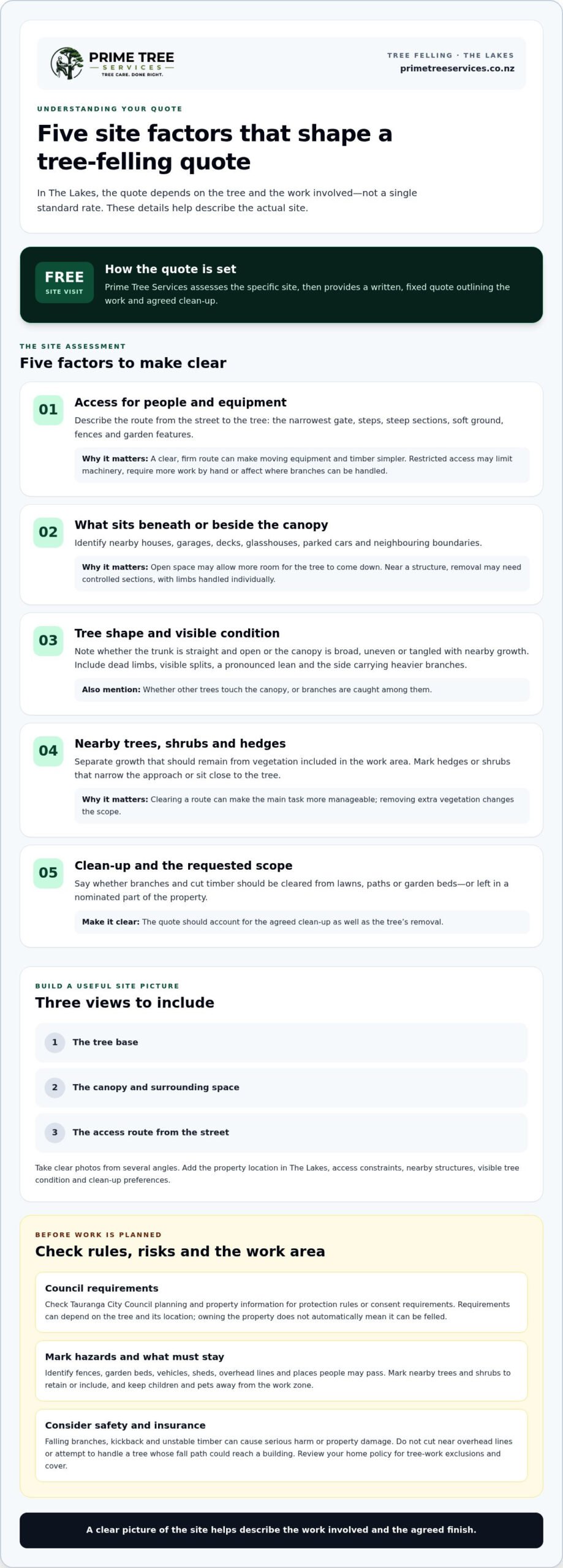
If you’re estimating how much for tree felling in The Lakes, access and the tree’s condition are key factors. Prime Tree Services assesses the specific site during a free visit, then provides a written, fixed quote that sets out the work and agreed cleanup.
- Map the route for people and equipment. Note the narrowest gate, steps, steep sections and soft lawn between the street and the tree. A clear, firm route can make moving equipment and timber simpler. A restricted route may limit machinery, require more work by hand or affect where branches can be handled. Include fences and garden features that could obstruct movement.
- Show what sits beneath the canopy. Mark the house, garage, deck, glasshouse, parked cars and neighbouring boundary beneath or beside the branches. An open area may allow more room for the tree to come down. Where a structure occupies that space, removal may need to happen in controlled sections, with limbs handled individually. This affects the sequence and care involved.
- Describe the tree’s shape and condition. A straight, open trunk differs from a tree with a broad, uneven canopy or branches tangled with nearby growth. Dead limbs, visible splits and a pronounced lean can affect how removal is approached. Note which side carries the heavier branches and whether other trees touch the canopy. These details help describe the work required.
- Separate the tree from the surrounding job. Identify shrubs, hedges and small trees that restrict access, distinguishing those you want retained from growth included in the work area. Clearing a route can make the main task more manageable, while removing extra vegetation changes the scope. Specify whether branches and cut timber should be cleared or left in a nominated part of the property.
- Prepare one clear description for the quote request. Give the property location in The Lakes, explain access constraints, name nearby structures and describe the tree’s visible condition. Add photos of the base, canopy and surrounding space, plus your cleanup preferences. To understand how much for tree felling in The Lakes, describe the actual site rather than assuming it is open and easy to access.
For a site-specific quote, send through your tree-felling details, including access and nearby buildings.
Property owners in The Lakes often need to consider local boundaries and access pathways multiple times a day. If your tree work involves challenging local terrain, describe the available access and how nearby buildings, garden features and the canopy relate to the work area. Keep the tree’s visible condition distinct from shrubs or other growth you want included, so the requested scope is clear.
Explain whether the route is narrow, stepped, steep or soft, and identify where branches and cut timber should be left or cleared. Note limbs beneath structures, visible splits, dead branches, a lean or canopy contact with other trees. Photos of the base, canopy and surrounding space can support those details. This gives the quote request an accurate picture of the site and its access.
What permits or council rules apply to removing trees in The Lakes, Tauranga?
Establish the property’s planning status before scheduling tree work. In The Lakes, check Tauranga City Council requirements and any property-specific protections. Don’t assume a tree can be removed simply because it stands on private land.
- Check the property records and planning information. Find the correct address and any planning details attached to the site. Look for references to protected trees, landscape features or consent requirements, then ask Tauranga City Council what they mean for the specific tree. A rule applying to one property or tree doesn’t automatically apply to the whole neighbourhood.
- Identify the exact tree before asking about requirements. Note its position, species if known, and whether it stands near a boundary, road or shared space. Photos of the trunk, canopy and surroundings can help identify it. Don’t rely on a neighbour’s past tree work as evidence that the same rules apply to your property.
- Confirm who owns or controls the land. A tree beside a fence may stand on a boundary, shared accessway or council-managed reserve rather than solely within your property. Check your property plan and discuss the boundary with the relevant owner where needed. Don’t arrange removal of a tree on another person’s land or public space without first resolving authority.
- Ask whether any approval applies before work begins. Give Tauranga City Council the address, tree location and any planning details you found. Ask whether the tree is protected and whether a resource consent or other approval is required for the proposed removal. Keep the council’s written response with your property records so the scope and decision are clear.
- Keep the planned work within the approved scope. If a council response or consent sets conditions, read them before arranging the work. Check that the identified tree, proposed removal and required safeguards match the actual job. Don’t treat permission to prune one tree as permission to remove another, or assume conditions cover nearby shrubs and hedges.
- Resolve uncertainty before setting a date. Gather the address, tree photographs, property details and council correspondence together. If the property is part of a shared development, check relevant body corporate or property-management records too. These steps help clarify approvals and permissions before the work is arranged.
Don’t assume a protected tree or one on a notable-tree schedule can be felled. Ask Tauranga City Council whether removal is allowed and whether resource consent or another approval is required before arranging the work.
In a Masterton District Council park, only Council contractors may use chainsaws legitimately.
Prime Tree Services: Tree Removal & Felling
Prime Tree Services can help when a tree’s size, condition or position makes removal difficult to plan. Its Tree Removal & Felling service covers tree removal, while Tree Pruning & Canopy Care may suit trees that need management rather than removal. Hedge Cutting & Shaping or Shrub Pruning & Clearance can also address nearby growth that obstructs the work area.
For The Lakes properties, share the tree’s location, access constraints, nearby buildings and any council information with your quote request. The price depends on the case and is provided after a quote request, with site access, tree condition, proximity to structures and the agreed cleanup affecting the assessment.
Contact Prime Tree Services to discuss tree work at your property.
Set up your next step
To understand how much tree felling in The Lakes may cost, first decide the result you want. Is the priority removing a problem tree, maintaining a healthy canopy or opening up an overgrown boundary? That choice helps shape a discussion about the work your property needs, rather than treating every tree as a removal job.
Prime Tree Services offers Tree Removal & Felling, Tree Pruning & Canopy Care, and Hedge Cutting & Shaping. If your plans involve more than one area, describe the outcome you want, such as clearing a view while retaining valued trees. A clear plan helps define the work for your outdoor space.
When you’re ready, share your property details and preferred outcome with Prime Tree Services to arrange a free site visit. Note which trees or garden features you’d like to keep, so the written, fixed quote reflects your priorities.
A clear plan can help make your outdoor space work better for you.
Frequently Asked Questions
What is the average cost of tree felling in The Lakes, Tauranga?
If you’re asking how much tree felling costs in The Lakes, there isn’t one standard price for every property. Prime Tree Services assesses the site during a free visit and provides a written, fixed quote. The quote sets out the specific work, so you can review the scope before proceeding.