Could a palm on your Tauranga commercial site be causing cracks or lifted paving, or are its roots following a weakness that was already there? That distinction matters when investigating commercial palm root damage tauranga businesses are concerned about. Removing a tree before tracing the likely cause can disrupt access without resolving the underlying issue.
When paving, walls or nearby infrastructure show damage, site managers need to know what has changed and what requires attention. But signs of damage don’t prove the palm caused it. A measured assessment can help identify what to look for and what the evidence may suggest.
This article explains how to investigate suspected palm-related damage, what information to gather and how an arborist’s assessment fits into a wider site response. It also covers when palm care or removal may be appropriate, while recognising that repairs to paving, structures or services may need separate trades.
Key Takeaways
- Lifted paving or cracks near a palm are signs to investigate, not proof that its roots caused the damage.
- For commercial palm root damage tauranga concerns, record what has changed and map the damage in relation to the palm before deciding what to do.
- An arborist’s site observations can help assess the palm, but may not establish the cause of structural damage.
- Palm care or removal can address the tree; damage to paving, walls or services may need a separate repair plan.
How palm root damage can affect a Tauranga commercial site
Imagine a site manager notices raised paving beside a palm and a crack running towards a retaining wall. That’s a reason to investigate, not proof that the palm is responsible. For commercial palm root damage tauranga concerns, start by recording where the signs appear and what has changed. Then consider the tree observations alongside the site evidence.
A warning sign is a prompt to investigate, not proof of the cause.
Which site features may need closer inspection?
Look for lifted paving, uneven joints or cracks, and note any changes in nearby walls or structures. Record each sign’s location in relation to the palm and whether it appears to be changing. Proximity alone doesn’t confirm root damage. Suspected damage to buried pipes or cables is different from visible surface changes and needs appropriate investigation. Don’t treat surface clues as confirmation of a problem below ground.
Palm health is a separate consideration. Ganoderma zonatum (butt rot) is a fungal pathogen associated with decay in palms, but a tree-health issue by itself doesn’t establish why paving or a wall has changed.
Why a commercial site needs a measured response
Plan observations around how the site operates. Staff, customers, deliveries and accessible paths all affect where people can safely inspect or work, and how to limit disruption. Mark the affected area on a simple site plan, including nearby access routes, so the investigation stays focused while normal activity continues where practical.
If grounds planning also includes nearby vegetation work, hedge removal in Tauranga may be part of the site’s maintenance plan. Keep that work separate from investigating the palm and any possible damage. A site-specific arborist assessment can inform decisions about palm care or removal; repairs to paving, retaining walls or services may require separate work.
How to assess whether palm roots are linked to site damage
Start with the pattern of damage, not an assumption. An arborist can observe the palm and its position in relation to the affected area, noting visible changes around the tree. These observations can inform the investigation, but don’t necessarily establish why paving, a retaining wall or another structure has moved. For commercial palm root damage tauranga concerns, keep observations about the tree distinct from confirmed findings about the structure.
A palm’s proximity to damage is a clue to investigate, not proof that its roots caused it.
What evidence helps build a clearer picture?
Before deciding on tree work, make a straightforward record. Note when the issue was first seen, where it appears and whether it has changed. Take dated photographs from consistent positions so you can compare them over time. On a site plan, mark the palm, affected spots and nearby structures, along with useful details such as paths and access areas. This gives the arborist a clearer picture of the site and helps distinguish observations from assumptions.
- Record visible changes and the date they were noticed.
- Show the palm and affected areas on a site plan.
- Keep suspected buried-service issues separate from visible surface damage.
When tree work is only one part of the assessment
An arborist assesses the tree and can inform decisions about its care or removal. That work alone may not identify the cause of structural movement or confirm damage to underground services. Building or retaining-wall concerns may need assessment by a relevant building or structural specialist, while suspected service damage needs an appropriate service investigation. A tree assessment is not a structural diagnosis.
If the evidence points to a tree-management decision, Prime Tree Services provides palm and yucca care and removal as part of a wider site response. A site-specific arborist assessment can help clarify the tree-related next step. Discuss your palm concern with the team as you organise the investigation.
A Tauranga commercial palm case study: from site concern to next steps
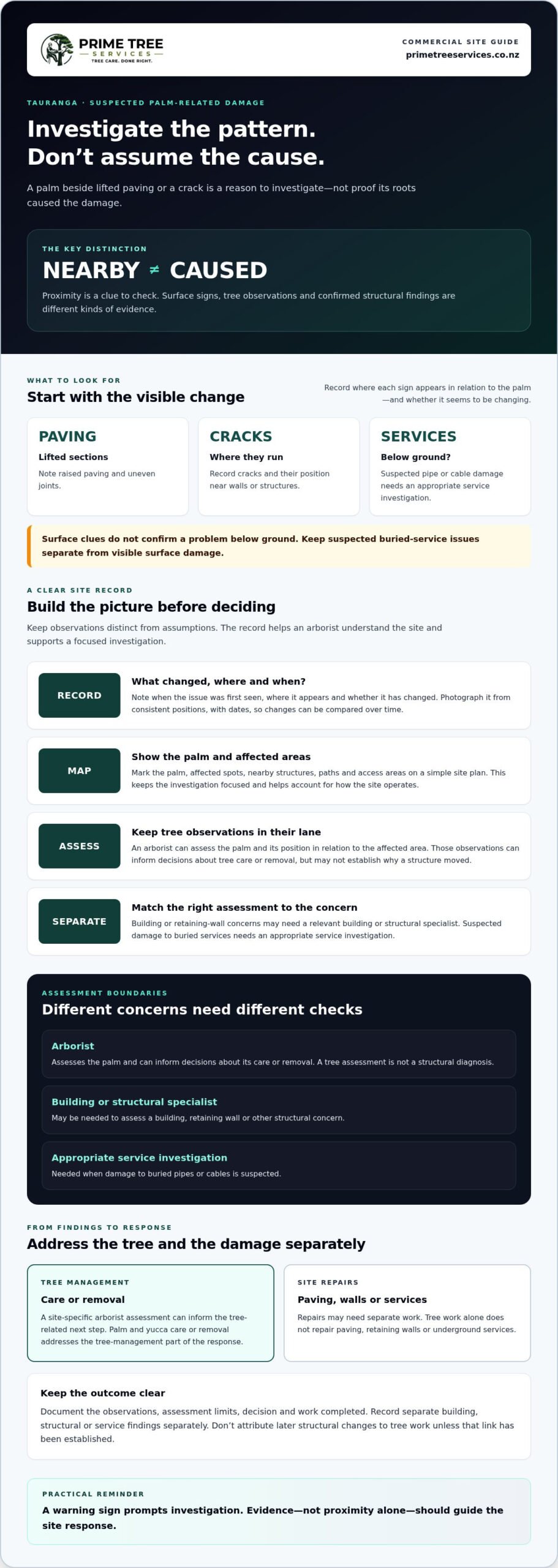
Consider a commercial site where a manager notices a raised section of paving beside a palm. The useful case record begins with what was observed, rather than a conclusion about the cause. For commercial palm root damage tauranga concerns, document the evidence and keep the tree assessment separate from conclusions about structures.
How the site concern should be investigated
Start with the site manager’s specific concern: what changed, where it appeared and when it was first noticed. Add dated photographs and a site plan showing the palm, affected paving or wall, and nearby features. An arborist can record observations about the palm and its position. These details inform the investigation, but don’t by themselves prove what caused structural movement or suspected damage to buried services.
Record any separate building, structural or service assessment if it takes place, and state its findings separately. This keeps observed facts distinct from assumptions and makes the eventual decision easier to follow.
How the response should be chosen
Match the decision to what the assessment establishes. If the tree needs care or removal, palm and yucca cleaning and removal can address the tree-management part of the response. It won’t, by itself, repair paving, retaining walls or underground services. Document what tree work occurred, and don’t attribute later structural changes to it unless that link has been established.
A commercial palm removal guide for Tauranga businesses can help managers consider the decision, but the site record should reflect the evidence gathered at their own property.
Keep the sequence clear: concern, observations, assessment limits, decision and documented outcome. This provides a sound basis for a site-specific response without treating a nearby palm as the cause by default.
Practical next steps for commercial palm root concerns in Tauranga
A documented approach helps site managers decide what needs attention without disrupting more of the site than necessary. For commercial palm root damage tauranga concerns, gather the evidence first, then arrange an assessment that fits the issue. Tree work may address the palm, but it won’t automatically repair paving, a retaining wall or underground services.
What to prepare before arranging tree work
- Document the signs. Take dated photos from consistent positions and note when changes were first noticed. Include cracks, lifted paving and any visible changes to the palm.
- Map the location. Mark the palm, affected areas, nearby structures and access routes on a simple site plan. Note where staff, customers or deliveries need to move through the work area.
- Gather relevant records. Include details of previous repairs, inspections or known service locations, where available. This gives the assessment useful context without treating past observations as proof of cause.
- Arrange the right assessment. An arborist can assess the palm and discuss tree-care or removal options. Structural concerns and suspected service damage may need separate assessment by the relevant specialist.
Choose a response that fits the documented issue
If the assessment points to palm work, palm and yucca care and removal can address the tree-management part of the response. Plan work around site access and normal operations, and treat repairs to structures or services as a separate part of the plan. If an adjacent hedge restricts access to the palm or work area, include that in the site plan; hedge removal in Tauranga may be relevant to the wider preparation.
Keep the records together so the site team can track what was observed, assessed and decided. A measured plan makes it easier to coordinate tree work with separate repairs, without assuming removal will resolve every sign of damage.
To discuss the palm work involved, Get A Free Quote.
Move from site concern to a considered plan
A suspected palm issue doesn’t have to lead straight to a removal decision. Use the information gathered on site to set out what needs attention, who needs to assess it and how work can fit around daily operations. Keeping the tree decision separate from property repairs helps avoid expecting one job to solve two different problems.
For commercial palm root damage tauranga concerns, Prime Tree Services can help with the tree-management side. The Tauranga team provides palm and yucca care, pruning and removal, alongside tree removal and felling. The right approach depends on the palm and the work required at the site.
When you’re ready to plan the tree work, a clear assessment can help your team move forward while keeping site needs in view.
A measured approach helps you care for the site and make practical decisions one step at a time.
Frequently Asked Questions
Can palm roots damage paving or a retaining wall?
Yes, palm roots can be associated with damage to nearby paving or structures, but the risk depends on the site and can’t be judged from distance alone. In commercial palm root damage tauranga investigations, treat lifted pavers or a new crack as reasons to examine the area, not proof against the palm. Note where the change begins and whether it continues along the wall or path.
How can I tell whether a palm caused cracking on a commercial site?
You can’t confirm the cause from the crack’s appearance alone. Compare the affected area with older maintenance records or dated site photographs to establish when the change appeared, then have the palm and structure assessed in their own context. For example, a crack that was present before the palm became a concern changes the timeline, but still doesn’t establish what caused it.
Will removing a palm stop existing root damage?
Removing a palm may address the tree, but it won’t straighten lifted paving or repair an already cracked retaining wall. Existing damage needs its own assessment and repair plan. Before work begins, make sure the site team understands which area is being addressed by tree removal and which issues remain for follow-up. This keeps the expected outcome clear and avoids treating removal as a structural fix.
Do palm roots grow back after a palm is removed?
The removed palm’s roots don’t usually grow back into the same tree, though root material may remain in the ground and break down over time. What happens depends on the palm and how it was removed. If there are other palms nearby, keep track of which plant is being observed so new growth isn’t mistakenly attributed to the removed tree.
Should a commercial property manager remove a palm if paving is lifting?
Not solely because paving is lifting. First establish what’s known about the palm, the paving and any site constraints, then decide whether tree work is warranted. In Tauranga, also check whether the tree is protected before planning work: some protected trees require resource consent for removal or nearby construction. If removal is appropriate, plan for access and arrange paving repairs separately.