A tree that looks rough doesn’t automatically need to come down. If you’re considering when to remove a tree nz, a few dead branches, a lean or thinning leaves may raise questions, but they don’t tell the whole story on their own.
It’s understandable to worry about a tree near your home, driveway, fence or a neighbour’s property. Consider its condition alongside its location and what could be affected if it failed. Pruning or monitoring may address some concerns, and an arborist can assess the tree in context and explain suitable options.
This guide covers warning signs to take seriously, situations where removal may be justified, and when less extensive care may be enough. It also explains what to check with your local council before work begins, including whether protections or consent requirements apply to the specific tree and site. For Tauranga property owners, local arborist advice can help clarify the next step.
Key Takeaways
- When to remove a tree nz depends on its condition, surroundings and practical care options, not its appearance or the season alone.
- Changes to the canopy, trunk, roots or movement are reasons to seek an assessment, not proof that a tree is unsafe.
- Pruning or monitoring may be suitable alternatives to removal, depending on what an arborist finds on site.
- Before work begins, check who owns the tree and confirm current council rules for its location and status.
- Make an assessment more useful by noting what has changed, nearby buildings or boundaries, site access and any council advice.
When to remove a tree in NZ: start with evidence, not the season
A tree can look untidy, lose leaves or have a few dead branches without needing to be removed. The time of year alone doesn’t settle the question either. To work out when to remove a tree nz, consider the tree’s condition, what it could affect if it failed, and whether practical care could address the concern.
A warning sign deserves attention, but it isn’t the same as a confirmed need for removal. An arborist can assess the tree in its setting, taking into account nearby buildings, paths, fences, power lines and open space. The science of arboriculture covers the care and management of trees; an on-site assessment applies that knowledge to the tree and the conditions around it.
When removal may be considered: Removal may be one option if an assessment finds that a tree’s condition, exposure or location raises concerns that pruning or monitoring can’t suitably address. No single sign or rule decides every case.
Which changes in a tree deserve a closer look?
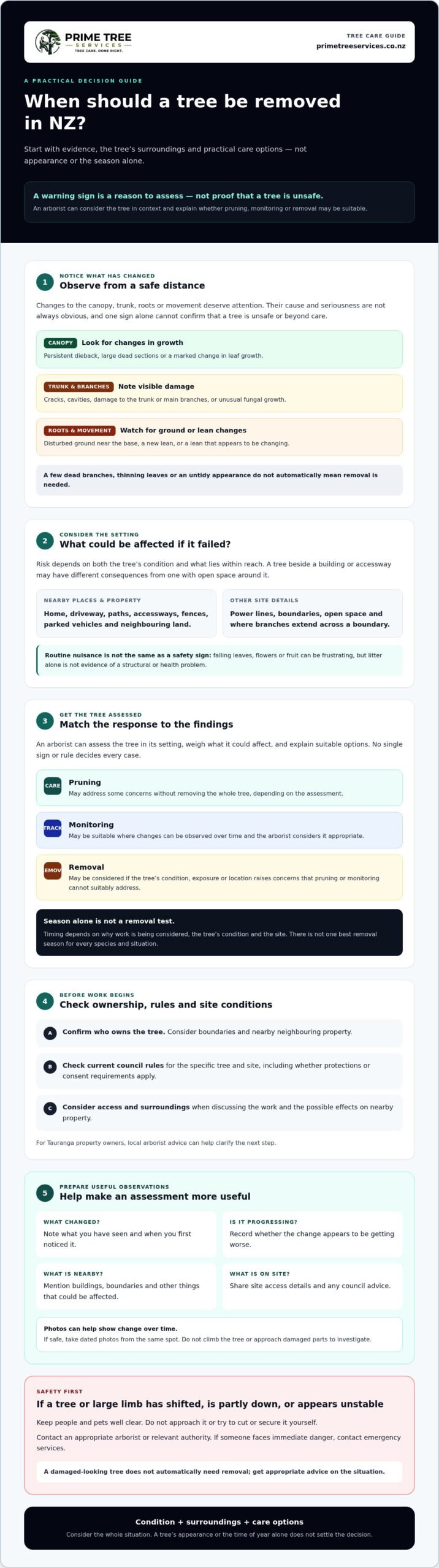
Take note of major dead sections in the canopy, a new or increasing lean, or substantial damage to the trunk or main branches. Changes around the roots, such as disturbed ground, are also worth reporting. These observations are prompts for a closer assessment, not a diagnosis. One sign by itself can’t confirm that a tree is unsafe or beyond care.
Record when you first noticed the change and whether it appears to be progressing. A dated photo taken from a safe position can help show what has changed over time. Don’t climb the tree or approach damaged parts to investigate. Share what you’ve seen with an arborist instead.
Why season alone is not a removal test
The right timing depends on why work is being considered, the tree’s condition and the site. A seasonal preference may matter for a particular tree or job, but it doesn’t replace an assessment of the evidence and practical options. There isn’t one best removal season for every species and situation.
A preferred season can guide timing, but evidence and site conditions should guide the removal decision. If you’re unsure, an arborist can help determine whether removal, pruning or monitoring is the more suitable next step.
Tree health and safety signs that call for an arborist assessment
Some changes are easy to spot from the ground, but their cause and seriousness aren’t always obvious. Treat them as reasons to seek an assessment, not as proof that a tree is unsafe. For anyone considering when to remove a tree nz, an arborist needs to assess both what’s happening to the tree and what it could affect at that site.
What canopy, trunk and root-zone changes can indicate
Look out for changes you can describe without getting close or climbing. These may include:
- Canopy: persistent dieback, large dead sections or a marked change in leaf growth.
- Trunk and main branches: visible cracks, cavities, damage or unusual fungal growth.
- Root zone and movement: disturbed ground near the base, a new lean or a lean that appears to be changing.
Each sign can have different causes, and a single feature doesn’t confirm imminent failure or mean the tree is beyond care. From a safe distance, note what you’ve seen and when it began. Photos taken from the same spot over time can help an arborist understand whether the change is progressing.
How location changes the level of concern
Consider what lies within reach if a branch or the whole tree failed. A tree beside a house, driveway or accessway may have different consequences from one with open space around it. Also consider nearby fences, parked vehicles and neighbouring land, especially where branches extend across a boundary.
Risk depends on both the tree’s condition and what lies within reach. Falling leaves, flowers or fruit can be frustrating, but litter alone isn’t evidence of a structural or health problem. An assessment can help distinguish routine upkeep from concerns that need a closer look.
If a tree or large limb has shifted, is partly down, or appears unstable, keep people and pets well clear. Don’t approach it or try to cut or secure it yourself. Contact an appropriate arborist or relevant authority. If someone faces immediate danger, contact emergency services. This is a safety step, not a reason to assume every damaged-looking tree needs removal.
A site assessment can put visible signs into context and help identify whether pruning, monitoring or removal may be suitable. The New Zealand Arboricultural Association is a useful source of information about arboriculture in New Zealand. Tauranga property owners can also seek a local tree assessment to discuss what they’ve noticed and the options for the tree.
Removal, pruning or monitoring: which response fits the tree?
The right response depends on what an on-site assessment finds, what you’re trying to address and whether the tree can remain safely and appropriately managed. Removal isn’t the only option. If you’re asking “when to remove a tree nz”, this comparison can help frame a discussion with an arborist, but it can’t replace an assessment of the tree and its setting.
| Option | When it may be considered | Who should assess suitability |
|---|---|---|
| Pruning or canopy care | Selected branches need attention, clearance is an issue, or canopy management may help meet the intended outcome. | An arborist, who can assess the tree and recommend suitable work. |
| Monitoring | An assessment finds no immediate need for work, but changes should be observed over time. | An arborist can advise what to watch for and whether a follow-up assessment is appropriate. |
| Removal | The tree’s condition, the risks at its location or site constraints make other options unsuitable. | An arborist should assess the tree on site before removal is decided. |
When pruning or crown reduction may address the issue
Pruning may be suitable if the concern relates to particular dead or damaged branches, clearance near a building or accessway, or the shape and spread of the canopy. Crown reduction may also be considered when managing the canopy is appropriate. The work should suit the tree and the intended outcome, rather than being treated as an automatic fix for every concern.
The key question is whether targeted care can address the issue while allowing the tree to remain safely and appropriately managed. An arborist can explain what pruning may achieve and whether it’s a practical alternative to removal.
When removal may be the more suitable option
Removal may be recommended where an on-site assessment identifies serious decline, significant structural concerns or site constraints that leave no suitable way to manage the tree in place. The recommendation should reflect the specific tree and its surroundings, not a single visible sign viewed in isolation.
If the tree can instead be managed through pruning or monitoring, those options may be worth discussing. An arborist can compare the choices and explain why one approach may fit better, helping you make a considered decision rather than rushing to remove a tree that may still be manageable.
Before removing a tree in NZ: check rules, boundaries and site conditions
Before arranging tree work, check that you’ve identified the right tree, that the right person has authority to organise the work, and that any local requirements are clear. Rules can depend on the tree’s location, status and current planning controls. Don’t assume a tree is exempt or protected based on its appearance or species alone. If you’re researching when to remove a tree nz, make these checks before work is booked.
A pre-work checklist
- Identify the tree. Note its address and exact position on the property. Photos or a simple site sketch can help distinguish it from nearby trees.
- Check ownership. Confirm the tree is on your land, particularly if it’s close to a boundary or appears to sit across more than one property.
- Confirm the rules. Contact the relevant council to ask whether the tree has any current protection, scheduling or other planning controls, and whether the proposed work needs consent.
- Arrange an assessment. Once you know what checks apply, discuss the tree’s condition, the work area and suitable options with an arborist.
What to check with Tauranga City Council
For a Tauranga property, check current Tauranga City Council planning information for the specific address and tree. Ask whether the tree is covered by any protection, schedule or other planning control, whether the proposed work needs consent, and what information council requires to answer your query. Requirements can vary with the site and the work proposed, so seek confirmation rather than relying on a general rule or an online assumption.
Species and appearance aren’t enough to establish a tree’s status. If you’re unsure which planning information applies, give council the address, the tree’s location and a clear description of the work you’re considering.
Ownership, neighbours and access to the work area
Boundary trees can be easy to misjudge from the garden. Check the tree’s location and ownership before giving the go-ahead, and speak with affected neighbours where access or nearby property may be involved. If ownership or the boundary is disputed, get appropriate New Zealand advice rather than relying on a visual estimate.
Also tell the arborist about narrow driveways, fences, buildings and other obstacles around the work area. These details help with assessing practical access and planning suitable work while taking neighbouring property into account.
Once council requirements and site details are clearer, arrange a Tauranga tree assessment to discuss the tree and suitable next steps.
Getting a tree assessment in Tauranga: practical next steps
A clear next step can turn a nagging concern into a practical plan. If you’re still weighing up when to remove a tree nz, start by recording what you’ve noticed and checking council requirements for the site. Then request an on-site assessment and compare the suitable options.
How to prepare for an arborist assessment
A few useful details can help the arborist understand the tree in its setting. Before the assessment, note:
- What has changed and when you first noticed it, including whether it seems to be progressing.
- The tree’s location and what’s nearby, such as a house, driveway, fence or neighbouring property.
- Access to the work area, including gates, narrow paths or other obstacles.
- Any council advice you’ve received about planning controls or consent.
Take clear photos from a safe position if they’ll help show the change. Don’t climb the tree, disturb the ground around it or get close to damaged sections to take a better picture. Share what you’ve observed, then let the arborist assess the tree on site.
What a clear recommendation should explain
Ask what the arborist observed, what practical concern those findings raise, and whether pruning or monitoring could be suitable instead of removal. A recommendation should also explain the proposed work and how site features, such as access or nearby structures, may affect how it’s carried out. If council has given you advice, share it so the options can be considered alongside those requirements.
Tree removal isn’t the only outcome. Prime Tree Services serves Tauranga and can assess a tree in its site context before discussing suitable work. Depending on the findings, options may include pruning, crown reduction or removal. The aim is to match the work to the tree and the property, rather than assuming one approach fits every situation.
If you’re in Tauranga and would like professional advice about a tree on your property, contact Prime Tree Services to discuss an assessment.
Make your next tree-care decision with confidence
The question of when to remove a tree nz is best answered with evidence, not a single change in appearance or the time of year. An arborist can assess the tree alongside nearby buildings, accessways and boundaries, helping you understand whether removal is justified or pruning, crown reduction or monitoring may be suitable.
Before work begins, check who owns the tree and confirm current council requirements for its location and status. These steps help clarify your options and any site considerations.
Prime Tree Services provides Tauranga-based tree care, including tree removal, pruning and crown reduction. If you’d like advice about a tree on your property, talk with Prime Tree Services about a tree assessment in Tauranga. With a practical assessment and the relevant information, you can choose a sensible next step for your property.
Frequently Asked Questions
When should a tree be removed in NZ?
A tree may be suitable for removal when an on-site assessment finds that its condition, location or site constraints can’t be managed appropriately through pruning or monitoring. Deciding when to remove a tree nz depends on the evidence and what could be affected if the tree or a branch failed. Visible changes are reasons to seek advice, not a diagnosis. Check local council requirements before arranging work, particularly if the tree may have protection or planning controls.
How can I tell if a tree is unsafe?
Look for changes that deserve assessment, such as persistent canopy dieback, visible cracks or cavities, a new lean, damaged branches or disturbed ground near the roots. None of these signs alone proves a tree is unsafe. Note when you first saw the change and whether it appears to be progressing, and take photos from a safe distance. An arborist can assess the tree’s condition alongside nearby buildings, paths and other potential targets.
Can a tree be saved instead of removed?
Yes, removal isn’t the only possible response. Depending on an on-site assessment, targeted pruning or canopy care may address selected branches, clearance concerns or canopy management needs. Monitoring may also be appropriate if no immediate work is recommended. Ask the arborist what each option can achieve and whether the tree can remain safely and appropriately managed. The answer depends on the particular tree, its condition and the space around it.
Do I need council consent to remove a tree in Tauranga?
It depends on the tree, its location and current planning controls, so check with Tauranga City Council before work starts. Ask whether the tree is protected, scheduled or subject to other controls, whether your proposed work needs consent, and what details council needs to check. Don’t assume a tree is unrestricted or protected based only on its species or appearance. Confirm the requirements for the specific address and tree.
Is there a best time of year to remove a tree in NZ?
No single season is best for every tree or situation. Timing depends on why work is being considered, the tree’s condition and the circumstances at the site. A seasonal preference may be relevant to particular work, but it doesn’t establish that removal is needed. First get advice on whether pruning, monitoring or removal is suitable, then discuss timing with the arborist and check any council requirements before work is arranged.
What should I do if a tree is leaning towards my house?
Keep an eye on it from a safe distance and arrange an arborist assessment, especially if the lean is new or appears to be changing. Don’t climb the tree, dig around its roots or try to brace or cut it yourself. Tell the arborist when you noticed the lean and describe the house, accessway or other property within reach. If the tree appears unstable or someone is in immediate danger, keep clear and contact the appropriate emergency service.
Should I remove a tree because its roots are near my house?
Not necessarily. Roots near a house don’t, by themselves, show that a tree needs removal or that it has caused damage. Note any changes you’re concerned about, such as visible ground disturbance or damage to a path, and seek appropriate professional advice rather than cutting roots yourself. An arborist can assess the tree and site, while a relevant building or property professional may be needed to assess suspected building damage.