Could the tree causing trouble be managed rather than removed? If you’re searching for “tree removal tauranga”, get a site-specific assessment before deciding. A tree may be dead, hazardous or taking up useful space, but pruning or crown reduction could sometimes address the issue while keeping it standing.
It’s understandable to worry about falling branches, damage to a roof or garden, and whether a crew can work around fences and tight accessways. A suitable plan takes account of the tree and its surroundings, so the work can be carried out with care and leave your property usable.
This guide covers when removal may be suitable, what a controlled job can involve and what to ask before accepting a quote. You’ll also learn how to compare local arborists, clarify what’s included and check whether council rules apply. With the right information, you can choose an approach that restores light, space or access without rushing into work the site may not need.
Key Takeaways
- A dead, unwanted or concerning tree may need assessment, but visible issues don’t automatically mean removal is the only option.
- For tree removal tauranga, the work plan should reflect the tree’s position, site access and nearby buildings, fences and gardens.
- Compare removal with targeted pruning or crown reduction to see whether you can achieve your goal while keeping the tree.
- Before agreeing to a quote, ask what work is included, how the crew will access the site and how nearby property will be considered.
- Check whether council rules apply to the tree, then confirm the scope with a local provider such as Prime Tree Services.
Tree removal in Tauranga: when is taking a tree down the right call?
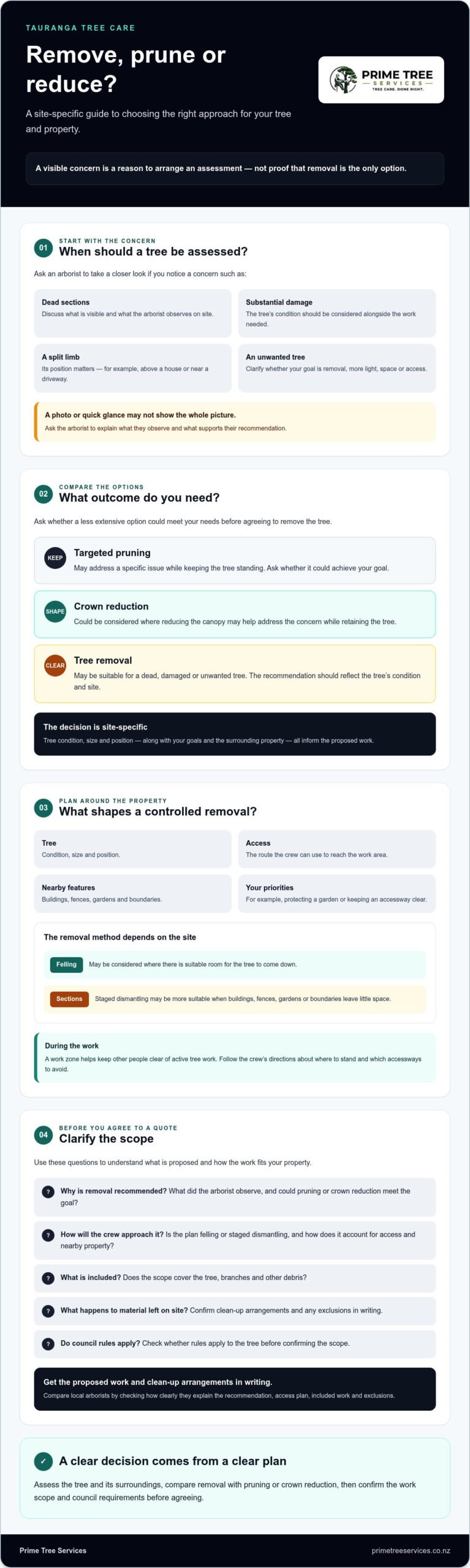
A dead tree, damaged trunk or canopy spreading over a roof can make removal seem like the obvious answer. Sometimes it is. But a concern visible from the ground is a reason to arrange an assessment, not a diagnosis on its own. The tree may be unwanted, obstruct an accessway or appear unsafe, but its condition and the work needed to address the issue should be considered together.
For tree removal tauranga property owners should look for a plan shaped around the actual tree and site. A job may involve felling where there’s suitable room, or dismantling the tree in sections where nearby buildings, fences, gardens or boundaries leave little space. The science of arboriculture includes tree care and risk management, but the practical decision still depends on conditions at your property.
What should prompt a tree removal assessment?
Dead sections, substantial damage, a split limb or a tree that has become unwanted are sensible reasons to ask for a closer look. Consider where the tree sits, too. A damaged branch above a house, or growth close to a driveway or boundary, may have different consequences from the same concern in an open part of the section.
These are signs to discuss, not a definitive checklist. A photo or quick glance may not show the whole picture, so ask an arborist to explain what they observe and what supports their recommendation. If you’re unsure how to weigh up what you’re seeing, the practical NZ guide on when to remove a tree covers warning signs to take seriously and situations where less extensive care may be enough.
What does a Tauranga arborist assess on site?
An on-site assessment considers the tree’s condition, size and position, along with nearby structures and access for the work. Tight access, a garden beneath the canopy or a fence close to the trunk can affect how the crew approaches the job. Explain your main concern so the arborist can focus the assessment on the outcome you want.
Ask what findings point to removal and whether pruning or crown reduction could meet your needs instead. If removal is appropriate, clarify whether the proposed approach is felling or staged dismantling, and how it accounts for the surrounding property. A clear explanation helps you understand the recommendation before agreeing to the work.
How professional tree removal in Tauranga is planned and carried out
A well-planned removal starts before any cutting begins. For tree removal tauranga properties, the crew needs to match its approach to the tree’s size and position, access and nearby features. A tree in an open section may allow a different method from one close to a house, fence or garden.
The removal method should be planned for the specific tree, access and surroundings, rather than treated as one-size-fits-all. This helps the crew manage the work area carefully and gives you a chance to confirm what will happen on your property.
From site assessment to an agreed scope
Show the arborist the tree and explain what matters to you, whether that’s protecting a garden, keeping an accessway clear or removing the tree completely. Discuss the route the crew can use to reach the work area, nearby property features and any boundaries to respect. These details help define a practical scope.
Before agreeing, ask for the proposed work and clean-up arrangements in writing. Check whether the scope covers the tree only or also branches and other debris, and clarify what happens to material left on site. It’s better to know about exclusions upfront.
What happens during controlled removal?
The crew chooses between felling and staged dismantling based on the site. Where there isn’t enough clear space for a whole tree to come down, dismantling it in sections may be more suitable. The work plan also accounts for access and nearby structures, helping the crew carry out the job in a controlled way.
A work zone keeps other people clear of active tree work. Follow the crew’s directions about where to stand and which accessways to avoid while work is under way. Cutting, climbing and handling tree sections are jobs for appropriately equipped professionals, not a weekend DIY project.
WorkSafe New Zealand’s arboriculture safety and health guidelines provide a useful reference for understanding safety in professional tree work. You can also ask the arborist how the planned approach accounts for hazards and constraints at your property.
Clear communication helps you understand what to expect, from the first visit through to the agreed clean-up. To talk through a tree and its site conditions, discuss tree removal options with Prime Tree Services.
Tree removal, pruning or crown reduction: compare your Tauranga options
Removing a tree is one way to change a yard, but it isn’t the only one. The right option depends on what you want to address, the tree’s condition and its position relative to the house, accessways and other parts of the property. A request for more light, better clearance or a smaller canopy may call for a different job from a tree that’s dead, unwanted or considered hazardous.
When considering tree removal tauranga options, ask the arborist to explain how each recommendation would meet your goal. Removal takes the tree down; pruning and crown reduction retain it while changing part of its canopy. No option suits every tree or site.
When might pruning or crown reduction be considered?
Targeted pruning focuses on selected branches or particular canopy-care needs. It may be worth discussing if your concern relates to specific growth or clearance, rather than wanting the whole tree gone. Crown reduction reduces a tree’s height or spread, aiming to retain its natural form while making the canopy smaller. For business owners managing trees across a site, the commercial tree pruning Tauranga guide for business buyers covers how to match pruning work to operational needs and site-specific outcomes.
Be clear about the result you want, such as more light over a seating area, improved clearance near a building or less canopy extending across part of the section. An arborist can assess whether pruning or reduction suits the tree and site, then explain what change you can reasonably expect. If the overgrown growth along your boundary is a hedge rather than a single tree, this commercial hedge trimming Tauranga guide explains how to choose between trimming, pruning and removal.
When might full tree removal be the suitable option?
Removal may be considered if a tree is dead, hazardous or no longer wanted, or if its position conflicts with how you need to use the property. The recommendation should account for the tree’s condition, location and your intended outcome. If removal is proposed, ask what supports that choice and whether pruning or reduction could address the concern instead.
Think of the options by purpose:
- Pruning: addresses selected branches or canopy-management needs.
- Crown reduction: reduces height or spread while aiming to retain the tree’s form.
- Removal: takes the tree down when keeping it doesn’t suit its condition or your plans.
When discussing the tree, explain what you want to change and ask the arborist to compare suitable options. That way, the recommendation can fit the site rather than defaulting to removal.
Choosing a Tauranga tree removal service: questions to ask before booking
Quotes are easier to compare when each provider is pricing the same work. For tree removal tauranga, look beyond the bottom line: check whether the proposed approach suits the site, whether the scope is clear and how the crew plans to account for the parts of your property that are staying.
What should a tree removal quote explain?
A useful written quote identifies the tree and proposed work, including the approach and any site conditions that affect access. Ask what’s included for debris and clean-up, what the crew needs to reach the work area and whether any tasks are excluded. Don’t assume two quotes cover the same work just because both describe tree removal. Understanding the tree removal cost NZ factors that shape your quote — such as access, tree condition and whether waste removal is included — can help you compare proposals on equal terms.
Before accepting, make sure you understand:
- Scope: Which tree is being removed, and what work is included?
- Access and work area: Where will the crew enter, and how will people be kept clear of active work?
- Property care: How will the plan account for nearby buildings, fences, gardens and accessways?
- Debris and clean-up: What will be removed, what will be left, and are there any exclusions?
- Experience: Has the provider handled similar trees or site conditions? Ask what makes this job comparable.
Clear answers help you spot gaps before work starts. If a detail matters, such as keeping an accessway usable or protecting a garden bed, ask for it to be recorded in the agreed scope.
Which local rules or site conditions should you check?
Check current Tauranga City Council guidance before arranging work, particularly if the tree may be protected or notable. Council rules can differ depending on a tree’s status and location. A tree on council land, such as a road reserve or grass berm, follows a separate approval process from a tree on private property. Don’t assume every tree can be removed without checking.
Tell the provider about shared boundaries, tight access and any nearby services you know of. Ask how these conditions affect the proposed plan, and clarify who will check relevant requirements before work proceeds. If you’re unsure whether council consent or another approval applies, confirm it with Tauranga City Council rather than treating a quote as proof that approval isn’t needed.
For a clear discussion of your tree and site conditions, talk with Prime Tree Services about tree removal.
Book tree removal in Tauranga with a clear plan for your property
A considered decision starts with the concern, not an assumption that the tree must come down. Explain what you’ve noticed, arrange an assessment and ask whether removal, pruning or crown reduction best fits the tree and your plans for the property. Before agreeing to work, make sure the proposed scope and site arrangements are clear.
What information should you have ready?
A few practical details can help start a useful conversation about tree removal tauranga:
- Property location: Share the Tauranga address or area and identify which tree you mean.
- Your concern: Explain whether the tree is unwanted, appears damaged or is affecting how you use the section.
- Site conditions: Mention tight access, nearby buildings, fences, boundaries and garden areas that need consideration.
- Photos: Share images if requested, but treat them as background information, not a substitute for an on-site assessment where one is needed.
Be specific about the outcome you want, such as clearing space or addressing a concern near a building. This helps the arborist understand your priorities. You can also ask what further information is needed to assess the tree and shape a suitable work plan.
What to expect when you contact Prime Tree Services
Prime Tree Services is an independently owned Tauranga arborist business providing tree removal and felling for local properties. When you get in touch, discuss the tree, available access and any parts of the property you’re particularly keen to protect. Ask how the assessment will inform the proposed approach, what the scope includes and how site conditions will be considered.
If removal may not be necessary, ask about pruning or crown reduction as alternative tree-care options. If you manage trees on a business property and want to understand how pruning can be scoped around daily operations, the commercial tree pruning Tauranga business buyer’s guide outlines what to discuss when setting a site-specific scope. Understanding the choices before settling on the work can help you avoid committing to a solution that doesn’t suit the tree.
To discuss your property and the work you’re considering, discuss your Tauranga tree removal needs with Prime Tree Services.
Choose a tree plan that suits your property
The right decision starts with understanding the concern and assessing the tree and its position before settling on removal. Pruning or crown reduction may be worth discussing if you want to manage the canopy without taking the whole tree down. If removal is recommended, a clear scope helps you understand the proposed approach and what’s included.
For tree removal tauranga, Prime Tree Services provides tree removal and controlled felling across Tauranga, with pruning and crown reduction available as options to discuss where appropriate. Sharing the tree’s location, your concerns and any access constraints can help start a practical conversation about your site.
Discuss your Tauranga tree removal needs with the team and ask about assessment, options and the proposed work scope.
Frequently Asked Questions
When should I consider tree removal in Tauranga?
Consider tree removal in Tauranga if you notice dead sections, significant damage, unwanted growth or a tree positioned close to a building or accessway. These concerns are reasons to arrange an arborist assessment, not proof that removal is necessary. The tree’s condition, surroundings and what you want to achieve on your property all matter. Ask for a site-specific professional opinion before deciding whether removal or another approach is appropriate.
Do I need council approval to remove a tree in Tauranga?
Whether approval is needed depends on the tree’s status, location and current Tauranga planning rules. Some trees, including those listed as notable or protected, may require resource consent, while trees on council land have separate approval requirements. Check the latest information with Tauranga City Council before arranging work, and ask for clarification if you’re unsure whether a rule applies to your tree. Don’t assume approval is always required or never needed.
Can a tree be pruned instead of removed?
Yes, pruning or crown reduction may suit some goals without removing the whole tree. Targeted pruning addresses selected branches or canopy needs, while crown reduction decreases height or spread while aiming to retain the tree’s natural form. The right option depends on the tree’s condition, position and your intended outcome. Ask an arborist to compare what each approach could achieve rather than assuming removal is the only solution.
How does a professional arborist remove a tree near a house?
An arborist assesses the tree’s size and condition, available access and nearby structures before choosing a method. Depending on the site, the plan may involve controlled felling or dismantling the tree in stages. Ask how the work area will be managed and how the plan accounts for your house and other nearby property. Leave climbing and cutting to appropriately equipped professionals; don’t attempt hazardous tree work yourself.
What should I ask a tree removal company before accepting a quote?
Ask what work the quote includes, how the crew will access the site and how nearby buildings, fences and gardens will be considered. Check what happens to branches and other debris, what clean-up is included and whether any tasks are excluded. Request a written scope so you can compare like-for-like proposals. A headline figure alone won’t tell you whether different quotes cover the same work or arrangements.
Does tree removal include taking away the branches and wood?
Not necessarily. Debris handling and clean-up depend on the provider and agreed scope, so confirm arrangements before booking. Ask specifically whether branches, trunk sections and other material will be removed, left on site or handled another way. Don’t assume taking away tree material or supplying firewood is included. Having the details recorded in the quote helps avoid confusion about what will remain on your property after the work.
Can tree removal damage my garden, driveway or fence?
Tree work involves site-specific access and handling, so no method can promise zero impact. An assessment helps identify nearby gardens, driveways, fences and other property features that need consideration in the work plan. Point out anything you’re concerned about before work begins, then ask how the crew will manage access and the work area. Confirm the agreed arrangements in writing so expectations are clear before the job starts.