Could the tree that looks most damaged on your Tauranga site be less urgent than one with a smaller, less obvious warning sign? Visible changes matter, but a practical check also considers what a tree could affect and how people, vehicles and day-to-day work move around it. If you’re considering commercial hazardous tree removal tauranga, it can be difficult to judge what needs attention without either overreacting or overlooking a genuine concern.
This checklist will help you record observable warning signs, note nearby people, buildings, vehicles and access routes, and decide when to request an on-site assessment from an arborist. You don’t need to diagnose the tree yourself. Start with what you can see and how the site is used, then share those details to help plan sensible next steps. Removal is only one possible outcome when a tree needs closer assessment.
Key Takeaways
- For commercial hazardous tree removal tauranga, record visible concerns rather than trying to diagnose whether a tree is unsafe.
- Check the trunk, branches, canopy and surrounding ground, and note changes you can describe to an arborist.
- Map nearby entrances, walkways, work areas, parking and neighbouring property to show what could be exposed.
- Consider how site activity changes during opening hours, shift changes, deliveries and quieter periods.
- An on-site assessment can help determine whether monitoring, pruning, reduction or removal is appropriate and support practical work planning.
Commercial hazardous tree removal in Tauranga: start with this site-risk checklist
Noticing a possible tree hazard is a reason to pay closer attention, not proof that the tree is unsafe or will fail. When considering commercial hazardous tree removal tauranga, begin with what you can see from a safe distance. Then consider who or what could be exposed and how the site is used.
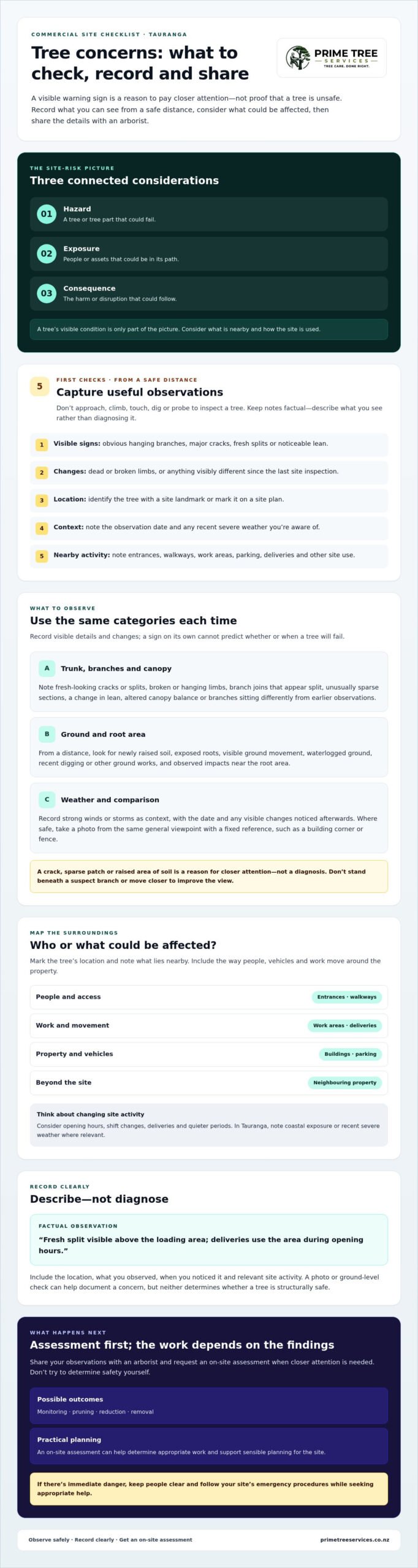
A useful first check covers four things: the tree’s visible condition, nearby people and assets, activity around the site, and what needs to happen next. Record the tree’s location and any changes you’ve noticed. In Tauranga, note whether the site is exposed to coastal conditions or has recently experienced severe weather, where relevant. These details give an arborist useful context, but don’t replace an on-site assessment.
What counts as a hazardous tree on a commercial property?
In plain terms, a hazard is a tree or tree part that could cause harm if it failed. The visible concern is only part of the picture. Also consider the people, buildings, vehicles or work activity within reach. Arboriculture involves managing trees in their surroundings, as outlined in the science of arboriculture. A photo or ground-level check can help document what you’ve noticed, but neither can determine whether a tree is structurally safe.
The first five checks to make from a safe distance
Don’t approach, climb or touch a tree to inspect it. From a safe position, note:
- Any obvious hanging branches, major cracks, fresh splits or noticeable lean.
- Dead or broken limbs, and visible changes since the last site inspection.
- The tree’s location, using a site landmark or a marked-up site plan.
- The date of your observation and any recent severe weather you’re aware of.
- Nearby entrances, walkways, work areas, parking, deliveries or other site activity.
Keep your notes factual. Describe what you see rather than labelling the tree as dangerous. For example, write “fresh split visible above the loading area; deliveries use the area during opening hours” rather than guessing what caused the split or predicting failure.
For a commercial site, hazard is the tree or part that could fail, exposure is the people or assets in its path, and consequence is the harm or disruption that could follow. If your observations suggest the tree needs closer attention, arrange an on-site arborist assessment. Removal may be considered, but the appropriate work depends on the findings.
Tree warning signs: what Tauranga site managers can observe safely
Use the same simple categories each time you record a tree concern. This makes changes easier to compare and gives an arborist clear observations to review. Describe what you can see, not what you think may be happening inside the tree. A crack, sparse patch or raised area of soil is a reason for closer attention, not a diagnosis.
One sign on its own can’t predict whether a tree will fail or when. Its significance depends on the wider picture, including what has changed and what lies nearby. Don’t enter a suspected danger area to get a better look. If there’s immediate danger, keep people clear and follow your site’s emergency procedures while seeking appropriate help.
Trunk, branch and canopy signs worth recording
From a safe position, note fresh-looking cracks or splits, broken or hanging limbs, and branch joins that appear split. Look for unusually sparse sections, a change in the tree’s lean, an altered canopy balance or branches sitting differently from earlier observations. These are visible details only. Don’t try to decide whether they indicate decay or structural weakness.
If it’s safe to do so, take a photo from the same general viewpoint and include a fixed reference, such as a building corner or fence, to show location and scale. Add the date and compare it with earlier site records if available. Don’t move closer, stand beneath a suspect branch or climb to improve the view.
Ground and weather changes around trees
From a distance, look for newly raised soil, exposed roots or visible ground movement near the tree. Record waterlogged ground, recent digging or other ground works, and any impact near the root area that you’ve observed. Don’t dig, probe the soil or push against the tree to test what you see.
Note strong winds or storms as background information, along with the date and any visible changes noticed afterwards. Weather alone doesn’t establish that a tree is damaged or unstable. For context on safe arboriculture work, WorkSafe New Zealand provides New Zealand’s code of practice. Site managers should leave tree assessment and work planning to appropriate professionals.
Clear records can make a discussion about commercial tree work in Tauranga more useful. Prime Tree Services provides tree removal and felling, as well as pruning and canopy care, using arborist techniques and specialised equipment. The right work depends on the site and professional assessment, so removal isn’t automatic.
Assess who and what a hazardous tree could affect on your site
A tree concern is easier to assess when you map it against the people and activity around it. A visible issue beside a rarely used boundary may create a different exposure from one above a busy entrance, loading area or parking row. When considering commercial hazardous tree removal tauranga, look at the site as it operates, not just how it appears during a quiet inspection.
Identify people, assets and everyday activity nearby
Mark where staff, customers, contractors and visitors may pass or gather. Include buildings, parked vehicles, stored materials, access routes and areas that support important business operations. Then note when those places are used. Opening hours, shift changes, deliveries, public access and seasonal activity can all change who may be exposed.
A simple record can make the comparison clear:
- Observed concern: a branch appears to extend over the staff entrance.
- People or assets exposed: staff and visitors using the doorway, plus the entrance itself.
- Site activity: foot traffic at opening and closing, with deliveries nearby.
- Next detail to check: whether another entrance or route is available if access needs to change.
This isn’t a technical risk rating. It’s a practical way to show an arborist what you’ve noticed and how the site functions. A guide from the International Society of Arboriculture describes a systematic process for assessing tree risk. Professional assessment considers more than a visual concern in isolation.
Create a clear record for the next decision
Use a site plan or annotated photo to mark the tree, nearby exposure points and the usual routes people take. Add the date, what you observed, relevant weather context and any temporary access changes already made. Keep the record factual, and update it if site use or visible conditions change.
Risk depends on both the tree and what it could affect. A concern near a building, vehicle area or busy walkway needs context about who uses that space and when. This helps focus the next conversation without asking site staff to diagnose the tree.
Before arranging tree work, check whether the tree or location is subject to Tauranga City Council requirements or other site-specific restrictions. This may include checking the tree’s status, the property title or who controls the land. Verify what applies to the particular tree and site with the relevant authority before work is planned.
Prioritise the findings and decide what to do next
Use your observations to distinguish a possible immediate danger from a concern that needs a planned on-site assessment. Fresh major damage, a large hanging limb or sudden movement calls for prompt professional advice. If people may be in immediate danger, keep them away and contact appropriate emergency assistance. Don’t climb, cut branches, inspect roots up close or operate machinery near a suspect tree.
For other concerns, consider whether a temporary site measure is sensible while you arrange advice. Depending on the location and site operations, this could mean directing people to another access route or keeping an area clear. Make decisions for the specific site, document what has changed and don’t treat temporary measures as a substitute for professional advice.
When to seek prompt professional advice
Escalate concerns promptly if you notice a fresh split, a newly hanging limb or a change that appears sudden. Tell the arborist what has changed and who or what may be exposed. If the situation appears immediately dangerous, prioritise keeping people clear and follow your site’s emergency procedures while contacting appropriate emergency assistance.
How to prepare for an arborist site assessment
Make the visit more useful by gathering photographs taken from a safe position, your marked-up site plan and dated notes. Include relevant weather context, operating hours, affected access routes and any recent ground works. Explain where staff, customers, contractors, vehicles or buildings could be affected, and mention temporary access changes already made.
Ask what the assessment and proposed work involve, what site controls may be needed, and what cleanup is included. Depending on the findings, the recommendation might be monitoring, pruning, reduction or removal. For commercial hazardous tree removal tauranga, don’t assume removal is the only option or that every visible concern needs the same response.
Assign one person to manage the follow-up. Record who will contact an arborist, who will manage any interim site measures and when to review the concern if advice or work is not yet arranged. Check WorkSafe New Zealand guidance and relevant Tauranga City Council information, then verify which requirements apply to the specific tree, property and proposed work before proceeding.
Prime Tree Services provides tree removal and felling, along with pruning and canopy care, across Tauranga. If your site needs closer assessment or tree work, discuss the site and required tree work.
Plan hazardous tree work in Tauranga without rushing the decision
A flagged tree doesn’t automatically need to come down. After an on-site assessment, an arborist may recommend monitoring, pruning, tree reduction or removal, depending on the tree and its surroundings. When planning commercial hazardous tree removal tauranga, make sure you understand why an option is recommended and how the work can fit around normal site activity.
Before work is scheduled, identify the areas that may be affected, such as an entrance, car park, loading zone or staff walkway. Discuss access to the tree, any temporary restrictions and how they may affect deliveries, visitors or daily operations. Agree who will notify staff and site visitors, and how updates will be shared if arrangements change. Confirm the expected disruption and what cleanup is included so the site can be organised for the work and its return to normal use.
Questions to ask before agreeing to commercial tree work
Ask the arborist to explain how the proposed work responds to the observed concern and the people or assets potentially exposed. Clarify which parts of the site need to be kept clear, how the work area will be accessed, what disruption to expect and what cleanup is included. Check who will communicate any temporary restrictions to staff, contractors, customers and visitors.
Commercial tree work sits within the Health and Safety at Work Act 2015 framework. Discuss how health and safety will be managed for the specific work and site, and clarify what each party is responsible for. Requirements and arrangements can depend on the circumstances, so verify what applies rather than assuming one plan fits every property.
From recorded concern to a clearer, safer site
Before requesting advice, gather your dated observations, safe photographs, site plan and notes about operating hours, access and nearby activity. Share relevant changes or recent ground works. A clear picture of the site helps an arborist consider the concern alongside how the property is used.
Then confirm the recommendation and practical arrangements before work begins. This may include coordinating access, communicating restrictions and planning around affected work areas. Don’t promise removal to staff or site users before the tree and site have been assessed. The right response could be another form of tree care, or removal if the findings support it.
Prime Tree Services provides tree removal and felling, including for hazardous or dead trees, as well as pruning and canopy care across Tauranga. To discuss your observations and the tree work your site may need, discuss tree removal and arborist work with Prime Tree Services.
Take the next step with a clear site picture
A sensible response starts with clear observations, not assumptions. Record visible changes from a safe distance, map who and what could be affected, and note how site activity changes throughout the day. Then share those details with an arborist so the tree and its surroundings can be assessed before deciding whether monitoring, pruning, reduction or removal is appropriate.
For commercial hazardous tree removal tauranga, local site knowledge matters. Prime Tree Services works across Tauranga, providing tree removal and felling for hazardous, dead or unwanted trees. Its tree work uses arborist techniques and specialised equipment, with the recommended work based on the tree and site.
If you’ve recorded a concern and want to discuss suitable work, discuss hazardous tree removal with Prime Tree Services. Share your observations and site context to start a practical conversation about the next step.
Frequently Asked Questions
What are the signs that a commercial tree may be hazardous?
Possible warning signs include fresh cracks or splits, broken or hanging branches, a noticeable change in lean, unusually sparse canopy sections, or newly raised soil nearby. Record what you can see from a safe distance, along with the date and any changes since an earlier observation. These signs aren’t proof a tree will fail. If there appears to be immediate danger, keep people clear and seek appropriate help.
Who is responsible for assessing hazardous trees on a commercial property in New Zealand?
The business or organisation responsible for managing the workplace should arrange appropriate attention to tree-related risks, while health and safety responsibilities can depend on who controls the work and site. The Health and Safety at Work Act 2015 is relevant to workplace safety, but who holds particular duties depends on the circumstances. A site manager can record concerns and organise an on-site assessment from an arborist rather than trying to diagnose the tree.
Can I tell if a tree is dangerous by looking at it?
No. A visual check can highlight concerns but can’t confirm that a tree is dangerous or predict whether or when it might fail. Cracks, dead limbs or ground changes are useful observations to record, not a technical diagnosis. Keep your distance, take photos only from a safe position and share what you’ve noticed with an arborist. An on-site assessment is needed to consider the tree alongside its location and surroundings.
When should a business contact an arborist about a tree?
Contact an arborist when you notice a substantial new change, such as a fresh major split, a large hanging limb or sudden movement. If there appears to be immediate danger, keep people away and contact appropriate emergency assistance. For less urgent concerns, arrange an assessment and share your dated notes, safe photographs and site plan. If you’re researching “commercial hazardous tree removal tauranga”, remember that removal is only one possible recommendation.
Does a hazardous tree always need to be removed?
No. After assessing the tree and its surroundings, an arborist may recommend monitoring, pruning, tree reduction or removal. The right option depends on the findings and what the tree could affect on the site. Don’t assume a visible concern means removal is necessary, or that one response suits every tree. Ask the arborist to explain how the recommendation relates to the observed issue and nearby people, buildings, vehicles or site activity.
What information should I give an arborist about a commercial tree?
Share the tree’s location, dated observations, photos taken safely and any changes you’ve noticed. A marked-up site plan can show nearby entrances, walkways, work areas, parking, buildings and neighbouring property. Explain when people use those areas, including during deliveries or shift changes, and mention relevant weather, recent ground works and any temporary access changes. This practical context helps the arborist consider the concern alongside how your Tauranga site operates.
Do I need council approval to remove a tree in Tauranga?
Possibly. Tauranga City Council resource consent may be required for certain trees, including individually listed notable or protected trees, trees on council land, and trees in specified heritage, cultural or ecological areas. Restrictions may also apply near waterways or through a covenant or consent notice. Work affecting a council tree may require separate Asset Owner Approval. Check the tree’s status and the requirements for the specific property with Tauranga City Council before arranging work.